
| 일 | 월 | 화 | 수 | 목 | 금 | 토 |
|---|---|---|---|---|---|---|
| 1 | ||||||
| 2 | 3 | 4 | 5 | 6 | 7 | 8 |
| 9 | 10 | 11 | 12 | 13 | 14 | 15 |
| 16 | 17 | 18 | 19 | 20 | 21 | 22 |
| 23 | 24 | 25 | 26 | 27 | 28 | 29 |
| 30 | 31 |
- compositeboat
- Woodworking Machines
- boat terminology
- yacht design basics
- marineindustry
- NCRProcess
- marine engineering
- 선박용어사전
- 보트빌딩용어
- Gel Coat
- sailing vocabulary
- TAFE
- 보트빌딩
- Lofting
- boatbuilder education
- boatyard
- 요트제작
- Study Q&A
- frp보트
- TAFE Boatbuilding
- shipwright
- 로프팅
- 목공 기계
- TAFEBoatbuilding
- boatbuilding
- yachtbuilding
- TAFE보트빌딩
- 조선용어
- boatbuilding terms
- boat parts explained
- Today
- Total
The Yachtwright’s Legacy
Review: MEM25005B 선박 목재 부재 제작과 조립 본문
MEM25005B Construct and assemble marine vessel timber components
A note on sources
The unit codes and unit titles referenced in this post (e.g., the MEM/MSA codes) come from the Australian TAFE boatbuilding curriculum I studied over two years. Beyond borrowing that name and code, however, the actual written content was substantially researched, reorganised, and rewritten with the help of AI to reflect current boatbuilding practice — it is not a reproduction of any textbook, and in many places it differs significantly from the original course material.
If you are currently studying this unit, please treat this post as a personal study aid and general reference only — not as an accurate substitute for your actual coursework, assessment material, or your instructor's guidance. Always check your own institution's materials for anything that matters for assessment.
출처에 대한 안내
이 글에 언급된 과목 코드와 과목명(예: MEM/MSA 코드)은 제가 2년간 이수한 호주 TAFE 보트빌딩 과정에서 가져온 것입니다. 다만 그 이름과 코드를 가져온 것일 뿐, 실제 본문 내용은 AI의 도움을 받아 현재의 보트빌딩 관행에 맞게 상당 부분 조사하고 재구성하고 다시 쓴 것입니다. 특정 교재를 그대로 옮긴 것이 아니며, 여러 부분에서 원래 교재 내용과 상당히 다릅니다.
이 과목을 현재 수강 중이시라면, 이 글은 개인적인 학습 보조 자료이자 일반적인 참고용으로만 봐 주시고, 실제 수업 자료나 평가 자료, 강사님의 안내를 대신할 정확한 자료로는 여기지 말아 주세요. 평가에 반영되는 내용은 항상 소속 기관의 자료를 통해 확인하시기 바랍니다.
What this unit covers / 이 과목의 범위
MEM25005B deals with the practical skills used to select, prepare, join, and assemble timber structural components for a vessel — stringers, frames, stems, keels, bulkheads, and similar members — to the strength and durability standard the marine environment demands. This covers choosing appropriate species and grades of timber, preparing it correctly (moisture content, grain, defects), joining pieces together where a single length is not long or wide enough (scarfing, laminating), fastening components mechanically and/or with adhesive, and assembling them into the vessel structure in a sequence that avoids trapping stress or moisture. It complements the composites units, since a great many modern hulls use timber structural members inside an FRP or epoxy-composite skin.
MEM25005B은 선박의 목재 구조 부재 — 스트링거, 프레임, 스템, 킬, 격벽 등 — 를 해양 환경이 요구하는 강도와 내구성 기준에 맞게 선택·준비·접합·조립하는 실무 기술을 다룹니다. 적절한 수종과 등급의 목재를 선택하는 것, 이를 올바르게 준비하는 것(함수율, 결, 결점 확인), 한 조각의 길이나 폭이 충분하지 않을 때 조각들을 이어 붙이는 것(스카핑, 라미네이션), 기계적 체결이나 접착제(또는 둘 다)로 부재를 고정하는 것, 그리고 응력이나 수분이 갇히지 않도록 순서를 지켜 선박 구조로 조립하는 것까지 포함합니다. 오늘날 많은 선체가 FRP나 에폭시 복합재 외피 안에 목재 구조 부재를 사용하기 때문에, 이 과목은 복합재료 관련 과목들과도 이어집니다.
Timber Selection / 수종 선택
1. Species selection / 수종 선택
Species selection balances strength-to-weight ratio, natural durability/rot resistance, workability, and availability. Softwoods commonly used include Western Red Cedar (light, naturally rot-resistant, popular for strip-planking and cold-moulded skins) and Hoop Pine or Kauri (straight-grained, strong, traditionally favoured for stringers and structural framing). Hardwoods such as spotted gum or various marine-durable species are used where higher strength or abrasion resistance is needed, such as keels, stems, or rubbing strakes, at the cost of extra weight. Marine-grade plywood (typically okoume or meranti face veneers over a void-free core, bonded with a waterproof/boil-proof adhesive) is widely used for bulkheads, panels, and laminated structural members.
수종 선택은 강도 대 무게비, 자연적인 내구성·부식 저항성, 작업성, 구입 용이성의 균형을 고려합니다. 흔히 사용되는 침엽수로는 웨스턴 레드 시더(가볍고 자연적으로 부식에 강해 스트립 플랭킹과 콜드몰디드 외피에 널리 사용)와 후프 파인(Hoop Pine) 또는 카우리(Kauri, 곧은 결에 강도가 좋아 전통적으로 스트링거와 구조 프레임에 선호)가 있습니다. 스포티드 검(spotted gum)과 같은 활엽수나 여러 해양 내구성 수종은 킬, 스템, 러빙 스트레이크처럼 더 높은 강도나 내마모성이 필요한 부위에 사용되며, 그 대가로 무게가 늘어납니다. 해양등급 합판(보통 오쿠메나 메란티 표면 베니어를 공극이 없는 코어 위에 방수·내습성 접착제로 접합한 것)은 격벽, 패널, 라미네이트 구조 부재에 널리 사용됩니다.
2. Moisture content / 함수율
Timber must be dried (seasoned) to an appropriate moisture content before being worked and fastened together, since timber that is too wet will shrink and distort after assembly, opening up joints and stressing fastenings or glue lines as it dries further. A moisture meter is used to check timber before use rather than relying on appearance or feel, and timber should generally be brought close to the moisture content it will settle at in service before final shaping and joining — allowing it to acclimatise in the workshop environment for a period beforehand where practical.
목재는 가공하고 서로 체결하기 전에 적절한 함수율까지 건조(양생)되어야 합니다. 너무 젖은 목재는 조립 후 수축하고 뒤틀려, 이후 더 건조되면서 조인트가 벌어지고 체결부나 접착선에 응력을 가할 수 있기 때문입니다. 외관이나 촉감에 의존하지 않고 사용 전에 함수율계로 목재를 확인하며, 최종 성형과 접합 전에는 목재를 실제 사용 환경에서 안정될 함수율에 가깝게 맞추는 것이 일반적입니다. 가능하다면 사전에 작업장 환경에 일정 기간 순응시키는 것이 좋습니다.
3. Grain orientation and defects / 결 방향과 결점
Straight, consistent grain running the length of a piece is preferred for structural members, since grain that runs out at an angle (short grain) significantly weakens the piece along that length — a piece with short grain can look sound but fail well below its expected strength under load. Timber is checked for and generally rejected in structural applications if it shows significant knots (which locally disrupt grain), reaction wood (compression or tension wood formed under stress in the growing tree, which behaves unpredictably when machined and loaded), or sapwood in species where sapwood is notably less rot-resistant than heartwood.
구조 부재에는 길이 방향으로 일정하게 흐르는 곧은 결이 선호됩니다. 결이 비스듬히 빠지는(단결, short grain) 목재는 그 길이 방향으로 강도가 크게 약해지며, 겉보기에는 멀쩡해 보여도 하중을 받으면 예상 강도보다 훨씬 낮은 수준에서 파손될 수 있기 때문입니다. 목재는 구조용으로 사용하기 전에 검사하며, 결을 국부적으로 흐트러뜨리는 뚜렷한 옹이(knot), 성장 중인 나무가 응력을 받아 형성되어 가공·하중 시 예측하기 어렵게 거동하는 반응재(reaction wood, 압축재·인장재), 또는 심재보다 부식 저항성이 뚜렷이 낮은 수종의 변재(sapwood)가 눈에 띄면 일반적으로 구조용으로 사용하지 않습니다.
4. Marine plywood vs standard construction ply / 해양등급 합판과 일반 구조용 합판
| Property / 특성 | Marine ply / 해양등급 합판 | Standard construction ply / 일반 구조용 합판 |
| Core voids | Manufactured with a void-free (or near void-free) core across all veneers. 모든 베니어층에 걸쳐 공극이 없거나 거의 없는 코어로 제작됩니다. |
May contain internal voids or gaps, which weaken the panel locally and allow water ingress if the panel is later cut or damaged. 내부에 공극이나 틈이 있을 수 있어 패널을 국부적으로 약화시키고, 이후 절단되거나 손상될 경우 수분이 침투할 수 있습니다. |
| Adhesive | Bonded with a waterproof, boil-proof adhesive (e.g. to relevant marine plywood standards), intended for permanent wet-environment exposure. 방수·내습 등급 접착제(해당 해양 합판 규격 등)로 접합되며, 영구적인 습윤 환경 노출을 견디도록 만들어집니다. |
May use an exterior-rated adhesive that resists occasional weather exposure but is not necessarily rated for permanent immersion or constant damp conditions. 가끔의 기상 노출에는 견디는 실외용 접착제를 사용할 수 있지만, 영구 침수나 지속적인 습한 조건에는 적합하지 않을 수 있습니다. |
| Typical use | Bulkheads, hull/deck panels, laminated structural members, anywhere long-term wet exposure or high reliability is required. 격벽, 선체·데크 패널, 라미네이트 구조 부재 등은 장기적인 습윤 노출이나 높은 신뢰성이 요구되는 부위이다. |
Non-structural or short-life applications only, if used at all in a marine build. 선박 건조에 사용하더라도, 비구조용이거나 수명이 짧아도 되는 용도에 한정된다. |
A panel simply labelled "exterior grade" is not automatically equivalent to marine-grade plywood — always check the panel's actual manufacturing standard rather than the marketing description before using it structurally.
단순히 "실외용(exterior grade)"이라고 표시된 패널이 자동으로 해양등급 합판과 동등한 것은 아닙니다. 구조용으로 사용하기 전에는 항상 판매 문구가 아니라 패널의 실제 제조 규격을 확인해야 합니다.
Joinery & Lamination / 접합·라미네이션
5. Scarf joints / 스카프 접합
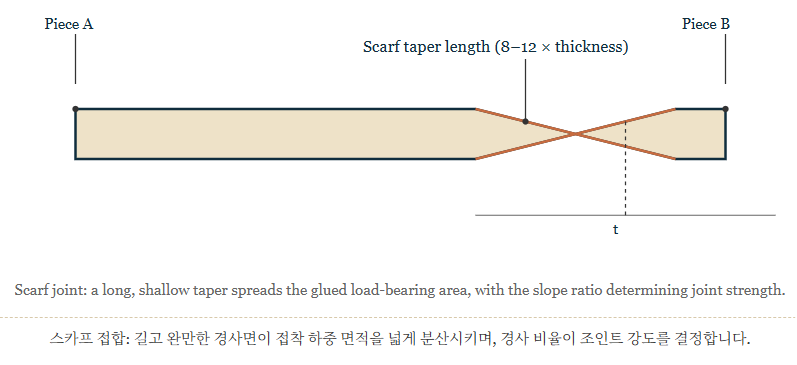
A scarf joint lengthens a piece of timber (or joins plywood panels edge-to-edge) by cutting a long, shallow taper on each mating piece and glueing the two tapers together, spreading the load over a large glued area rather than concentrating it at a simple butt joint. The slope ratio — the length of the taper compared to the material thickness — is critical: structural scarfs are typically cut at a ratio of around 8:1 to 12:1 (i.e. the taper runs 8 to 12 times the material's thickness), since a steeper, shorter taper reduces the glued surface area and weakens the joint significantly below the strength of the surrounding solid timber.
스카프 접합은 목재를 길게 잇거나(또는 합판 패널을 가장자리끼리 접합하기 위해) 맞닿는 두 조각에 길고 완만한 경사면을 깎아 서로 접착하는 방식으로, 단순한 맞대기 접합처럼 하중이 한 지점에 집중되지 않고 넓은 접착 면적에 걸쳐 분산되도록 합니다. 경사 비율(taper의 길이를 재료 두께와 비교한 값)이 핵심적인데, 구조용 스카프는 보통 약 8:1에서 12:1 비율로 깎습니다(즉, 경사면의 길이가 재료 두께의 8~12배). 더 가파르고 짧은 경사면은 접착 면적을 줄여 주변 원목 강도보다 훨씬 약한 조인트를 만들기 때문입니다.
6. Lamination and cold-moulding / 라미네이션과 콜드몰딩
Where a component needs a curved shape that solid timber cannot easily provide without excessive short grain — a curved stem, a compound-curved frame, or a full cold-moulded hull skin — thin strips or veneers of timber are laminated: bent around a mould or form, glued together layer by layer with epoxy, and clamped or vacuum-bagged until cured. Because each thin layer can bend to the curve without the grain running out, the finished laminated member keeps continuous, unbroken grain strength along its curved length — something a single solid piece cut to the same curve cannot achieve. Layer thickness, the number of layers, and glue line consistency all affect the final strength and stiffness of the laminated member.
원목으로는 과도한 단결(短結) 없이 얻기 어려운 곡선 형상 — 곡선형 스템, 복합 곡률 프레임, 또는 전체 콜드몰디드 선체 외피 — 이 필요한 부재는 얇은 목재 스트립이나 베니어를 라미네이트합니다. 몰드나 형틀에 둘러 구부린 뒤, 에폭시로 층마다 접착하고 경화될 때까지 클램프나 진공백으로 압착합니다. 각 얇은 층은 결이 빠지지 않고도 곡선에 맞게 휠 수 있기 때문에, 완성된 라미네이트 부재는 곡선 길이를 따라 연속적으로 끊기지 않는 결강도를 유지합니다. 이는 동일한 곡선으로 깎은 단일 원목 조각으로는 얻을 수 없는 특성입니다. 층 두께, 층수, 접착선의 일관성이 모두 완성된 라미네이트 부재의 최종 강도와 강성에 영향을 줍니다.
7. Traditional joints vs modern epoxy-bonded joints / 전통 조인트와 현대 에폭시 접합 조인트
Traditional mortise-and-tenon or halving joints rely purely on the mechanical interlock of the timber shapes, usually reinforced with mechanical fasteners, and depend on a snug, well-fitted mechanical joint for their strength. Modern wood-epoxy construction more commonly uses simpler butt or scarf joints reinforced and sealed with structural epoxy adhesive (sometimes further reinforced with fibreglass tape over the joint), which can achieve comparable or greater strength with less complex cutting, provided the glued surfaces are properly prepared and clamped. Traditional joinery remains relevant for restoration work, heritage-style builds, or where a fully mechanical, adhesive-free joint is specifically required.
전통적인 장부 접합(mortise-and-tenon)이나 하프랩 접합(halving joint)은 순전히 목재 형상의 기계적 맞물림에 의존하며, 보통 기계적 체결로 보강되고, 강도를 위해 꼭 맞고 정밀하게 가공된 기계적 조인트에 의존합니다. 현대의 우드에폭시 건조 방식은 더 흔히 단순한 맞대기나 스카프 접합을 구조용 에폭시 접착제로 보강·밀봉하며(때로는 조인트 위에 유리섬유 테이프로 추가 보강), 접착면이 적절히 준비되고 압착된다면 더 복잡하지 않은 가공으로도 비슷하거나 더 높은 강도를 얻을 수 있습니다. 전통 접합 기법은 복원 작업, 전통 양식 건조, 또는 접착제 없이 완전히 기계적인 조인트가 특별히 요구되는 경우에는 여전히 유효합니다.
Fastening & Assembly / 체결·조립
8. Mechanical fasteners / 기계적 체결재
Silicon bronze screws and fastenings are widely used in timber boatbuilding because bronze is highly corrosion-resistant in a marine environment and compatible with most timber species and treatments. Stainless steel fasteners are also used, but require care around galvanic compatibility — mixing incompatible metals in a wet, salty environment (for example, certain stainless grades against aluminium, or in oxygen-starved, wet timber pockets) can accelerate corrosion of one of the metals involved, so fastener material should always be selected as part of the overall material system, not chosen in isolation.
실리콘 브론즈 나사와 체결재는 목재 보트빌딩에서 널리 사용되는데, 브론즈가 해양 환경에서 부식 저항성이 매우 높고 대부분의 목재 수종·처리와 호환되기 때문입니다. 스테인리스강 체결재도 사용되지만, 갈바닉(이종금속) 호환성에 주의가 필요합니다. 습하고 염분이 있는 환경에서 호환되지 않는 금속을 함께 사용하면(예: 특정 스테인리스 등급과 알루미늄의 조합, 또는 산소가 부족한 습한 목재 틈새 등) 관련된 금속 중 하나의 부식이 가속될 수 있습니다. 따라서 체결재 재질은 개별적으로 선택하지 않고 항상 전체 재료 시스템의 일부로서 선택해야 합니다.
9. Glued fastenings: fillets and tape / 접착 체결: 필렛과 테이프
In modern epoxy-composite timber construction, many internal joints — such as where a bulkhead meets the hull, or a stringer meets a frame — are joined primarily with an epoxy fillet (a radiused bead of thickened epoxy run along the internal corner) reinforced with one or more layers of fibreglass tape laid over the fillet and wet out with epoxy. This "glued fastening" approach spreads load over a continuous bonded area rather than a series of discrete mechanical fastener points, and — done correctly — often outperforms mechanical fastening alone for both strength and long-term watertightness at the joint.
현대의 에폭시 복합재-목재 건조 방식에서는, 격벽이 선체와 만나는 지점이나 스트링거가 프레임과 만나는 지점과 같은 많은 내부 조인트를, 안쪽 모서리를 따라 두껍게 만든 에폭시를 둥글게 도포하는 에폭시 필렛과, 그 필렛 위에 덮어 에폭시로 함침시킨 한 겹 이상의 유리섬유 테이프로 보강하여 주로 접합합니다. 이러한 "접착 체결" 방식은 하중을 개별 기계적 체결 지점들이 아니라 연속된 접착 면적에 분산시키며, 올바르게 시공될 경우 강도와 조인트의 장기적인 방수성 모두에서 기계적 체결만 사용하는 것보다 대체로 더 우수한 성능을 보입니다.

10. Sealing timber before assembly / 조립 전 목재 밀봉
Structural timber members in a modern epoxy-composite build are typically sealed with epoxy on all surfaces — including internal faces that will be hidden once assembled — before or immediately after fitting, since any unsealed face left exposed inside a closed structure is a point where moisture can enter and become trapped, leading to rot that is difficult to detect or repair later. This full encapsulation is one of the main reasons wood-epoxy construction achieves better long-term durability than older methods that sealed only the visible, external surfaces of the timber.
현대의 에폭시 복합재 건조에서 구조용 목재 부재는 조립되면 가려질 내부 면을 포함한 모든 표면에 에폭시로 밀봉하는 것이 일반적이며, 이는 부재를 맞추기 전 또는 맞춘 직후에 이루어집니다. 밀폐된 구조물 안에서 밀봉되지 않은 면이 그대로 노출되어 있으면 수분이 침투해 갇히는 지점이 되고, 이는 나중에 발견하거나 수리하기 어려운 부식으로 이어질 수 있기 때문입니다. 이러한 완전 캡슐화(full encapsulation)는 우드에폭시 건조 방식이 목재의 보이는 외부 표면만 밀봉했던 옛 방식보다 더 나은 장기 내구성을 달성하는 주요 이유 중 하나입니다.
11. Assembly sequence / 조립 순서
Components are generally assembled working from the most dimensionally critical reference (such as the keel, centreline, or a jig/strongback already set up per the vessel's setting-out unit) outward, so that later components are always positioned and checked against a reliable, already-verified reference rather than against another recently fitted piece whose own position may still carry small errors. Fastening or bonding is generally sequenced to avoid trapping stress — for example, allowing a component to reach its natural, unforced position before final fastening, rather than forcing an ill-fitting piece into place and locking that stress permanently into the structure.
부재는 일반적으로 치수적으로 가장 중요한 기준(예: 킬, 센터라인, 또는 선체 세팅아웃 과목에 따라 이미 설치된 지그·스트롱백)에서부터 바깥쪽으로 조립해 나갑니다. 이렇게 하면 이후 조립되는 부재들이 최근에 맞춰진, 자체적으로 작은 오차가 남아 있을 수 있는 다른 부재가 아니라, 신뢰할 수 있고 이미 검증된 기준을 대상으로 위치가 결정되고 확인됩니다. 체결이나 접합 순서는 일반적으로 응력이 갇히지 않도록 계획됩니다. 예를 들어, 잘 맞지 않는 부재를 억지로 밀어 넣어 그 응력을 구조물에 영구히 가두는 대신, 부재가 최종 체결 전에 강제되지 않은 자연스러운 위치에 도달하도록 합니다.
Tools & Safety / 도구·안전
12. Tools and equipment / 도구 및 장비
| Tool / 도구 | Use / 용도 |
| Moisture meter | Checks timber moisture content before use, rather than relying on appearance or feel, as described above. 위에서 설명한 대로, 외관이나 촉감에 의존하지 않고 사용 전 목재의 함수율을 확인합니다. |
| Hand plane/spokeshave | Used for precise shaping and fitting of timber components, particularly along scarf tapers and curved edges. 특히 스카프 경사면과 곡선형 가장자리를 따라 목재 부재를 정밀하게 성형하고 맞추는 데 사용됩니다. |
| Thickness planer/thicknesser | Produces consistent-thickness strips or veneers for lamination work. 라미네이션 작업을 위한 일정한 두께의 스트립이나 베니어를 만듭니다. |
| Router with scarfing jig | Cuts consistent, accurate scarf tapers, particularly on plywood panels, more quickly and repeatably than hand-planing alone. 특히 합판 패널에서, 손대패 작업만으로 얻는 것보다 더 빠르고 반복적으로 일관되고 정확한 스카프 경사면을 절삭합니다. |
| Clamps/vacuum bag equipment | Holds laminated or glued components under even pressure while epoxy cures, critical to glue line quality and joint strength. 에폭시가 경화되는 동안 라미네이트되거나 접착된 부재를 균일한 압력으로 고정하는 것은, 접착선 품질과 조인트 강도에 매우 중요합니다. |
| Fillet tools/epoxy spreaders | Shape a consistent, smooth radius when applying epoxy fillets before taping, as described above. 위에서 설명한 대로, 테이핑 전에 에폭시 필렛을 도포할 때 일관되고 매끄러운 반경을 만듭니다. |
13. Safe working practices / 안전 작업 수칙
- Use dust extraction and appropriate respiratory protection when sanding or machining timber, since fine hardwood dust from many species is classified as a respiratory hazard and, for some species, a carcinogen with prolonged exposure.
- Wear gloves and appropriate skin protection when mixing and applying epoxy, since repeated skin contact with uncured epoxy resin and hardener is a common cause of skin sensitisation in boatbuilding.
- Follow correct guarding and safe operating procedures for power tools such as thicknessers, routers, and table saws, which present a significant risk of serious injury if guards are removed or bypassed.
- Ensure adequate ventilation when working with epoxy in enclosed spaces, and be aware that some hardeners produce irritating or harmful vapours even before the resin has begun to visibly cure.
- Follow safe manual handling practices when lifting and positioning longer timber components or completed laminated members, given their length, weight, and awkward balance.
- Store offcuts, sawdust, and solvent-soaked rags appropriately, since fine sawdust and solvent-soaked rags both present a fire risk if not stored and disposed of correctly.
- 목재를 샌딩하거나 가공할 때는 집진 장치와 적절한 호흡 보호구를 사용합니다. 많은 활엽수에서 나오는 미세한 목재 분진은 호흡기 위험물로 분류되며, 일부 수종은 장기간 노출 시 발암물질로 분류됩니다.
- 에폭시를 배합하고 도포할 때는 장갑과 적절한 피부 보호구를 착용합니다. 미경화 에폭시 수지와 경화제에 반복적으로 피부가 접촉하는 것은 보트빌딩에서 흔한 피부 알레르기 반응의 원인입니다.
- 두께 대패, 라우터, 테이블 톱과 같은 동력 공구는 올바른 방호장치와 안전한 작업 절차를 따라야 합니다. 방호장치가 제거되거나 우회되면 심각한 부상의 위험이 상당히 커집니다.
- 밀폐된 공간에서 에폭시 작업을 할 때는 충분한 환기를 확보하며, 일부 경화제는 수지가 눈에 보이게 경화되기 시작하기 전부터도 자극적이거나 유해한 증기를 발생시킬 수 있음을 유의합니다.
- 긴 목재 부재나 완성된 라미네이트 부재를 들어 올리고 배치할 때는 길이, 무게, 다루기 어려운 균형을 고려해 안전한 인력 취급 수칙을 따릅니다.
- 자투리 재료, 톱밥, 용제로 젖은 걸레는 적절히 보관합니다. 미세한 톱밥과 용제에 젖은 걸레는 모두 올바르게 보관·폐기하지 않으면 화재 위험이 있습니다.
'Marine Composites' 카테고리의 다른 글
| Review: MEM25007B 선박 표면 유지관리 (0) | 2026.07.29 |
|---|---|
| Review: MEM25006B 선박 시딩(외피 보강) 작업 (0) | 2026.07.28 |
| Review: MEM25004B 표면 페어링과 성형 (1) | 2026.07.26 |
| Review: MEM25003B 선박 구조물 셋업 (0) | 2026.07.25 |
| Review: MEM25002B 섬유강화 구조물 성형 및 접합 (0) | 2026.07.23 |


