
| 일 | 월 | 화 | 수 | 목 | 금 | 토 |
|---|---|---|---|---|---|---|
| 1 | ||||||
| 2 | 3 | 4 | 5 | 6 | 7 | 8 |
| 9 | 10 | 11 | 12 | 13 | 14 | 15 |
| 16 | 17 | 18 | 19 | 20 | 21 | 22 |
| 23 | 24 | 25 | 26 | 27 | 28 | 29 |
| 30 | 31 |
- 목공 기계
- Study Q&A
- TAFEBoatbuilding
- Woodworking Machines
- Lofting
- boatyard
- 보트빌딩
- frp보트
- boat terminology
- TAFE
- NCRProcess
- boat parts explained
- marine engineering
- yacht design basics
- 요트제작
- TAFE보트빌딩
- 선박용어사전
- boatbuilder education
- yachtbuilding
- TAFE Boatbuilding
- shipwright
- compositeboat
- sailing vocabulary
- Gel Coat
- 조선용어
- 로프팅
- boatbuilding terms
- 보트빌딩용어
- boatbuilding
- marineindustry
- Today
- Total
The Yachtwright’s Legacy
Review: MEM25003B 선박 구조물 셋업 본문
MEM25003B Set up marine vessel structures
A note on sources
The unit codes and unit titles referenced in this post (e.g., the MEM/MSA codes) come from the Australian TAFE boatbuilding curriculum I studied over two years. Beyond borrowing that name and code, however, the actual written content was substantially researched, reorganised, and rewritten with the help of AI to reflect current boatbuilding practice — it is not a reproduction of any textbook, and in many places it differs significantly from the original course material.
If you are currently studying this unit, please treat this post as a personal study aid and general reference only — not as an accurate substitute for your actual coursework, assessment material, or your instructor's guidance. Always check your own institution's materials for anything that matters for assessment.
출처에 대한 안내
이 글에 언급된 과목 코드와 과목명(예: MEM/MSA 코드)은 제가 2년간 이수한 호주 TAFE 보트빌딩 과정에서 가져온 것입니다. 다만 그 이름과 코드를 가져온 것일 뿐, 실제 본문 내용은 AI의 도움을 받아 현재의 보트빌딩 관행에 맞게 상당 부분 조사하고 재구성하고 다시 쓴 것입니다. 특정 교재를 그대로 옮긴 것이 아니며, 여러 부분에서 원래 교재 내용과 상당히 다릅니다.
이 과목을 현재 수강 중이시라면, 이 글은 개인적인 학습 보조 자료이자 일반적인 참고용으로만 봐 주시고, 실제 수업 자료나 평가 자료, 강사님의 안내를 대신할 정확한 자료로는 여기지 말아 주세요. 평가에 반영되는 내용은 항상 소속 기관의 자료를 통해 확인하시기 바랍니다.
What this unit covers / 이 과목의 범위
MEM25003B deals with the practical skills used to establish the structural framework of a vessel before planking, moulding, or lay-up begins: setting out baseline, centreline, and station reference lines from the lines plan or loft, erecting the strongback or building jig, positioning and aligning frames or mould stations, and fairing the whole structure so it presents a smooth, accurate shape for the hull skin to follow. Get the structure set up incorrectly at this stage, and every subsequent stage — planking, gel coat, finished fairness — inherits the error and becomes far harder to correct.
MEM25003B는 플랭킹, 몰딩, 또는 적층 작업이 시작되기 전에 선박의 구조 골격을 세우는 실무 기술을 다룹니다. 라인즈 플랜(lines plan)이나 로프팅에서 베이스라인, 센터라인, 스테이션 기준선을 세팅아웃하는 것, 스트롱백이나 빌딩 지그를 세우는 것, 프레임이나 몰드 스테이션을 배치하고 정렬하는 것, 그리고 선체 외피가 따라갈 매끄럽고 정확한 형상을 만들기 위해 전체 구조를 페어링하는 것까지 포함합니다. 이 단계에서 구조를 잘못 세팅하면, 이후 모든 단계 — 플랭킹, 젤코트, 최종 페어니스 — 가 그 오차를 그대로 물려받아 바로잡기가 훨씬 어려워집니다.
Reference Lines / 기준선
1. Baseline / 베이스라인
The baseline is a level, horizontal reference line from which all vertical heights on the lines plan and on the actual structure are measured. It does not need to touch the hull anywhere — it is simply an imaginary, perfectly level datum that every station, waterline, and frame height is dimensioned from. In the workshop, the baseline is physically established first, usually as a level string line or a laser plane running the length of the strongback, and every other reference line is set out relative to it.
베이스라인은 수평 기준선으로, 라인즈 플랜과 실제 구조물의 모든 수직 높이가 이 선을 기준으로 측정됩니다. 선체의 어느 부분에 실제로 닿을 필요는 없으며, 모든 스테이션·워터라인·프레임 높이가 치수를 갖는 가상의 완전 수평 데이텀(datum)입니다. 작업장에서는 베이스라인을 가장 먼저 물리적으로 설정하며, 보통 스트롱백 길이 방향을 따라 놓는 수평 스트링라인이나 레이저 평면으로 구현하고, 다른 모든 기준선은 이 베이스라인을 기준으로 세팅아웃합니다.
2. Centreline / 센터라인
The centreline is a longitudinal reference line running fore-and-aft through the exact middle of the hull, used to keep the port and starboard sides symmetrical and correctly aligned. It is typically established as a taut string line or laser line running the full length of the strongback at a fixed, known offset, and every station is centred and squared against it before being locked into place. Any drift in the centreline compounds along the length of the hull, so it is checked and re-verified at multiple points, not just set once at the start.
센터라인은 선체의 정확한 중앙을 지나며 앞뒤(선수-선미) 방향으로 이어지는 종방향 기준선으로, 좌현과 우현이 대칭이 되도록, 그리고 올바르게 정렬되도록 유지하는 데 사용됩니다. 보통 스트롱백 전체 길이를 따라 고정된 알려진 오프셋으로 팽팽하게 당긴 스트링라인이나 레이저 라인으로 구현하며, 모든 스테이션은 고정되기 전에 이 센터라인을 기준으로 중심을 맞추고 직각을 확인합니다. 센터라인의 미세한 오차는 선체 길이를 따라 누적되므로, 처음 한 번만 세팅하는 것이 아니라 여러 지점에서 반복적으로 점검하고 재확인해야 합니다.
3. Station lines / 스테이션 라인
Station lines are transverse (athwartships) reference lines spaced along the length of the hull at set intervals, taken directly from the lines plan — each one marks where a frame, mould, or bulkhead is positioned. Station spacing is not arbitrary: it is chosen at the design stage to capture the hull shape accurately, with closer spacing in areas of tighter curvature (such as the bow) and wider spacing where the shape changes more gradually (such as amidships). On the strongback, station positions are marked out first along the baseline and centreline, then transferred upward as vertical reference marks for each frame or mould to be erected against.
스테이션 라인은 라인즈 플랜에서 직접 가져온, 선체 길이를 따라 일정 간격으로 배치되는 횡방향(가로) 기준선으로, 각 라인은 프레임·몰드·격벽이 위치할 지점을 표시합니다. 스테이션 간격은 임의로 정해지는 것이 아니라, 선체 형상을 정확히 반영하기 위해 설계 단계에서 결정됩니다. 곡률이 급한 부위(예: 선수)에서는 간격이 좁고, 형상 변화가 완만한 부위(예: 선체 중앙)에서는 간격이 넓습니다. 스트롱백에서는 먼저 베이스라인과 센터라인을 따라 스테이션 위치를 표시한 뒤, 이를 각 프레임이나 몰드를 세울 수직 기준 표시로 전사(transfer)합니다.
4. Waterlines and buttock lines / 워터라인과 버톡라인
Waterlines are horizontal reference planes running parallel to the baseline at set height intervals, used on the lines plan to describe the hull's shape as if it were sliced horizontally at each height. Buttock lines are vertical, longitudinal planes running fore-and-aft parallel to the centreline at set offsets, describing the hull as if sliced lengthwise at each offset from the centre. Together with station lines, waterlines and buttock lines form the three-dimensional reference grid that both lofting and the physical structure are built against — this is the same "lines plan" grid used earlier in the lofting unit, now applied directly to setting up the real structure.
워터라인은 베이스라인과 평행하게 일정 높이 간격으로 배치되는 수평 기준면으로, 각 높이에서 선체를 수평으로 절단했을 때의 형상을 라인즈 플랜에 나타내는 데 사용됩니다. 버톡라인은 센터라인과 평행하게 일정 오프셋으로 배치되는 수직 종방향 기준면으로, 중심에서 각 오프셋만큼 떨어진 지점에서 선체를 세로로 절단했을 때의 형상을 나타냅니다. 스테이션 라인과 함께 워터라인·버톡라인은 로프팅과 실제 구조물 제작 모두의 기준이 되는 3차원 기준 격자를 형성합니다. 이는 앞선 로프팅 과목에서 사용한 것과 동일한 "라인즈 플랜" 격자를, 이제 실제 구조물 세팅업에 직접 적용하는 것입니다.

5. Transferring lines to the physical structure / 실제 구조물로 기준선 전사
Once the reference grid exists on paper (or in CAD/loft form), it has to be transferred accurately onto the strongback and station material. Traditional methods include a plumb bob dropped from a marked point to transfer a position vertically without error, a taut string line pulled between two fixed points to establish a straight reference, and a spirit level or water level to confirm a line is truly horizontal. A laser level now commonly replaces the string line and spirit level together, projecting a continuous, self-levelling reference plane along the whole strongback in one setup, which is faster and removes the small cumulative errors that can build up when re-checking a string line at multiple points by hand.
기준 격자가 도면(또는 CAD·로프팅) 상에 존재하면, 이를 스트롱백과 스테이션 재료에 정확히 전사해야 합니다. 전통적인 방법으로는 표시된 지점에서 플럼밥(추)을 내려 오차 없이 위치를 수직으로 전사하는 방법, 두 고정점 사이에 팽팽하게 당긴 스트링라인으로 직선 기준을 세우는 방법, 그리고 수평계나 물수평기로 선이 실제로 수평인지 확인하는 방법이 있습니다. 오늘날에는 레이저 레벨이 스트링라인과 수평계를 함께 대체하는 경우가 많아, 한 번의 설치로 스트롱백 전체를 따라 연속적인 자동 수평 기준면을 투사하며, 이는 더 빠르고 스트링라인을 여러 지점에서 수작업으로 재확인할 때 누적될 수 있는 작은 오차를 없애줍니다.
6. Setting-out tolerances / 세팅아웃 허용오차
Structural setting-out is not held to the same fine tolerance as, say, a machined engine component, but it is far from loose. As a general guide (always confirmed against the specific build's drawings or class society rules), station position along the baseline is typically held within a few millimetres, and centreline offset and squareness are checked to a similarly tight tolerance, since these errors compound over the length of the hull. Waterline height is usually the most forgiving of the three, but is still checked carefully wherever it affects trim or where systems (engine beds, tankage) depend on it.
구조물 세팅아웃은 예를 들어 정밀 가공된 엔진 부품과 같은 수준의 정밀 공차를 요구하지는 않지만, 결코 느슨하지도 않습니다. 일반적인 기준으로(항상 해당 건조물의 도면이나 선급 규정을 통해 확인해야 함), 베이스라인을 따른 스테이션 위치는 보통 수 밀리미터 이내로 관리되며, 센터라인 오프셋과 직각도 역시 비슷하게 엄격한 허용오차로 점검합니다. 이러한 오차는 선체 길이를 따라 누적되기 때문입니다. 워터라인 높이는 셋 중 가장 여유가 있는 편이지만, 트림에 영향을 주거나 엔진 베드·탱크 배치 등 시스템이 이를 기준으로 하는 경우에는 여전히 신중히 점검합니다.
Erecting Structure / 골격 설치
7. The strongback / building jig / 스트롱백·빌딩 지그
The strongback is the rigid backbone structure — usually a straight, level, well-braced timber or steel beam running the full length of the build — onto which every station, frame, or mould is erected and referenced. It must itself be perfectly straight and level before anything is erected onto it, because any twist or sag in the strongback transfers directly into every station mounted on it, and that error then transfers into the finished hull shape. The strongback is typically supported on adjustable stands or blocking so its level and straightness can be fine-tuned and re-checked as stations are added and the structure gains weight.
스트롱백은 건조물 전체 길이를 따라 이어지는 곧고 수평이며 튼튼하게 보강된 목재 또는 강재 빔으로, 모든 스테이션·프레임·몰드가 이 위에 세워지고 이를 기준으로 정렬됩니다. 스트롱백 자체가 어떤 것도 세워지기 전에 완벽하게 곧고 수평이어야 하는데, 스트롱백에 비틀림이나 처짐이 있으면 그 위에 설치되는 모든 스테이션에 그대로 전이되고, 그 오차는 다시 완성된 선체 형상으로 전이되기 때문입니다. 스트롱백은 보통 조정 가능한 스탠드나 받침목 위에 지지되어, 스테이션이 추가되고 구조물의 무게가 늘어나는 과정에서도 수평과 직진도를 미세 조정하고 재확인할 수 있도록 합니다.
8. Positioning and erecting frames / stations / 프레임·스테이션 배치 및 설치
Each frame or mould station is positioned at its marked station location on the strongback, then aligned to the centreline (for port/starboard symmetry) and checked for plumb (vertical alignment) before being temporarily braced in place. Stations are usually erected working from the middle of the hull outward toward the bow and stern, since the midship stations establish the primary reference that everything else is checked against, and errors are easier to catch early when there are fewer stations already fixed in place to work around.
각 프레임이나 몰드 스테이션은 스트롱백 위에 표시된 스테이션 위치에 배치된 뒤, 좌우 대칭을 위해 센터라인에 맞춰 정렬되고, 수직 정렬(plumb) 상태를 확인한 후 임시로 브레이싱(가지지대)으로 고정됩니다. 스테이션은 보통 선체 중앙에서부터 선수와 선미 쪽으로 작업해 나가는데, 미드십(중앙) 스테이션이 다른 모든 스테이션이 비교될 기본 기준을 세우기 때문이며, 이미 고정된 스테이션 수가 적을 때 오차를 더 쉽게 발견하고 바로잡을 수 있기 때문입니다.
9. Checking square / 직각 확인
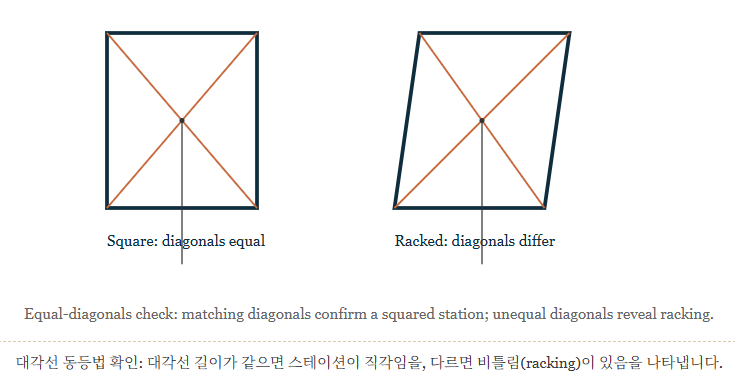
A station is checked "square" to the centreline using the equal-diagonals method: two diagonal measurements are taken from corresponding upper and lower corners across the station, and if both diagonals measure the same length, the station is square. If the diagonals differ, the station is racked (skewed) and needs adjustment before it is locked off — a small squareness error at one station, left uncorrected, distorts the fairness of the hull skin that will later be built over it.
스테이션이 센터라인에 대해 "직각"인지는 대각선 동등법(equal-diagonals method)으로 확인합니다. 스테이션의 상단과 하단 대응 모서리를 가로질러 두 개의 대각선 길이를 측정하며, 두 대각선의 길이가 같으면 스테이션은 직각입니다. 대각선 길이가 다르면 스테이션이 비틀려(racked) 있는 것이므로 고정하기 전에 조정해야 합니다. 한 스테이션의 작은 직각 오차라도 바로잡지 않고 두면, 이후 그 위에 만들어질 선체 외피의 페어니스(매끄러운 곡면)를 왜곡시킵니다.
10. Checking plumb and level / 수직·수평 확인
Plumb refers to true vertical alignment — checked with a plumb bob hung from a marked point, or a spirit level held vertically against the station — and confirms the station is not leaning forward, aft, or sideways relative to the baseline. Level refers to true horizontal alignment along a reference such as a waterline mark, checked with a spirit level or laser level. Both checks are made at multiple points on each station, not just once, since a station can appear correct at one point while being out of alignment elsewhere along its height or width.
플럼(plumb)은 진정한 수직 정렬을 의미하며, 표시된 지점에서 매달아 늘어뜨린 플럼밥이나 스테이션에 수직으로 대는 수평계로 확인합니다. 이는 스테이션이 베이스라인을 기준으로 앞뒤 또는 좌우로 기울어져 있지 않은지 확인합니다. 레벨(level)은 워터라인 표시와 같은 기준을 따른 진정한 수평 정렬을 의미하며, 수평계나 레이저 레벨로 확인합니다. 두 확인 모두 각 스테이션에서 여러 지점에 걸쳐 이루어져야 하며, 한 지점만 확인하고 끝내서는 안 됩니다. 스테이션이 한 지점에서는 정확해 보여도 높이나 폭의 다른 지점에서는 정렬이 어긋나 있을 수 있기 때문입니다.
11. Temporary bracing / 임시 브레이싱
Once a station is positioned, squared, plumbed, and levelled, it is held in that exact position with temporary bracing — diagonal timber struts or adjustable props fixed between the station and the strongback or floor — before any permanent fastening, bonding, or lay-up takes place. Bracing is left in place and re-checked periodically through the build, since vibration, added weight from later stations, or workshop temperature changes can shift an unbraced or under-braced structure slightly out of alignment before it is locked in permanently.
스테이션이 배치되고 직각·수직·수평이 확인되면, 영구적인 고정, 접합, 또는 적층 작업이 이루어지기 전에 임시 브레이싱 — 스테이션과 스트롱백 또는 바닥 사이에 고정하는 대각선 목재 지지대나 조정 가능한 받침대 — 으로 정확한 위치에 고정합니다. 브레이싱은 건조 과정 내내 그대로 두고 주기적으로 재확인해야 하는데, 진동, 이후 스테이션이 추가되며 늘어나는 무게, 또는 작업장 온도 변화가 브레이싱이 없거나 부족한 구조물을 영구 고정 전에 미세하게 정렬에서 벗어나게 할 수 있기 때문입니다.
Fairing & Checking / 페어링·검사
12. Fairing the structure / 구조물 페어링
Fairing is the process of checking and adjusting the whole erected structure so that a smooth, continuous curve runs across every station — with no local high spots (humps) or low spots (hollows) — before the hull skin, planking, or mould surface is built over it. Even if every individual station is correctly square, plumb, and level, the structure as a whole can still be "unfair" if the station heights or edge positions do not blend smoothly from one to the next, so fairing is always checked as a final pass across the whole assembled structure, not station by station in isolation.
페어링(fairing)은 선체 외피, 플랭킹, 또는 몰드 표면이 그 위에 만들어지기 전에, 전체 설치된 구조물을 점검하고 조정하여 모든 스테이션을 가로지르는 매끄럽고 연속적인 곡선을 만드는 과정입니다 — 국부적인 튀어나온 부분(hump)이나 들어간 부분(hollow)이 없어야 합니다. 개별 스테이션이 모두 정확히 직각·수직·수평이더라도, 스테이션 높이나 가장자리 위치가 서로 매끄럽게 이어지지 않으면 구조물 전체는 여전히 "언페어(unfair)"할 수 있습니다. 따라서 페어링은 스테이션 하나하나를 개별적으로가 아니라, 조립이 끝난 전체 구조물을 대상으로 하는 최종 점검 단계로 항상 진행합니다.
13. Fairing battens / 페어링 배튼
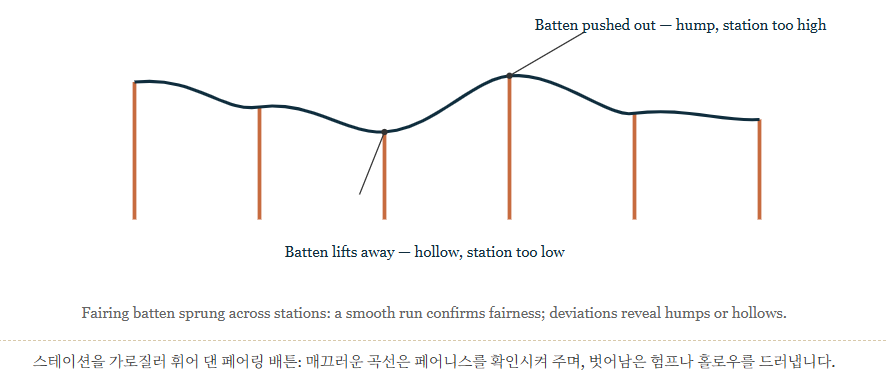
A fairing batten is a long, flexible strip of timber or composite material sprung around the outside of all the stations along the length of the hull, following the natural curve the material wants to take. Where the batten touches every station evenly with no gaps and no forced kinks, the structure is fair. Where the batten lifts away from a station, that station is set too low (a hollow); where the batten is pushed outward by a station, that station is set too high (a hump) — both are corrected by re-checking that station's position, height, and edge, then re-running the batten check until it lies smoothly across the whole length.
페어링 배튼은 선체 길이를 따라 모든 스테이션 바깥쪽에 휘어 대는 길고 유연한 목재 또는 복합재 스트립으로, 재료 자체가 자연스럽게 이루려는 곡선을 따라갑니다. 배튼이 틈이나 강제로 꺾인 부분 없이 모든 스테이션에 고르게 닿으면 구조물은 페어(fair)한 상태입니다. 배튼이 특정 스테이션에서 들뜨면 그 스테이션은 너무 낮게 설정된 것(hollow)이고, 배튼이 특정 스테이션에서 바깥쪽으로 밀려나면 그 스테이션은 너무 높게 설정된 것(hump)입니다. 두 경우 모두 해당 스테이션의 위치·높이·가장자리를 다시 확인하여 수정한 뒤, 배튼이 전체 길이에 걸쳐 매끄럽게 놓일 때까지 배튼 점검을 반복합니다.
14. Sighting and final checks / 육안 확인과 최종 점검
Alongside the physical batten check, an experienced eye sighting down the length of the structure from bow and stern — crouching low to sight along the sheer line and station edges almost horizontally — can pick up subtle unfairness that a batten alone might not fully reveal, particularly at the ends of the hull where curvature changes quickly. Photographs taken from a fixed low angle are increasingly used alongside sighting, since a photo can be reviewed carefully and compared against the lines plan without the viewer's eye needing to hold the whole curve in memory at once.
물리적인 배튼 점검과 함께, 숙련된 작업자가 선수와 선미 쪽에서 구조물 길이를 따라 육안으로 시야를 맞추는(허리를 낮춰 시어 라인과 스테이션 가장자리를 거의 수평에 가깝게 바라보는) 방법은, 특히 곡률이 급격히 변하는 선체 끝부분에서 배튼만으로는 완전히 드러나지 않을 수 있는 미묘한 언페어니스를 발견하는 데 도움이 됩니다. 고정된 낮은 각도에서 촬영한 사진을 육안 확인과 함께 활용하는 경우가 점점 늘고 있는데, 사진은 전체 곡선을 한 번에 기억할 필요 없이 라인즈 플랜과 신중하게 비교하며 검토할 수 있기 때문입니다.
Tools & Safety / 도구·안전
15. Tools and equipment / 도구 및 장비
| Tool / 도구 | Use / 용도 |
| Plumb bob | Transfers a position vertically without error, used to check plumb and to drop reference points from the loft or drawing down onto the structure. 위치를 오차 없이 수직으로 전사하며, 수직(plumb) 확인과 로프팅·도면에서 구조물로 기준점을 내리는 데 사용됩니다. |
| Spirit level | Confirms true horizontal (level) or vertical (plumb) alignment over short to medium distances. 단거리에서 중거리에 걸쳐 진정한 수평(level) 또는 수직(plumb) 정렬을 확인합니다. |
| Laser level | Projects a continuous, self-levelling reference line or plane over the full length of the strongback in one setup, reducing cumulative error compared to repeated string-line checks. 한 번의 설치로 스트롱백 전체 길이에 걸쳐 연속적인 자동 수평 기준선 또는 기준면을 투사하여, 반복적인 스트링라인 점검 대비 누적 오차를 줄여줍니다. |
| String line/chalk line | Establishes a straight reference between two fixed points, and can be snapped with chalk to mark a straight line directly onto material. 두 고정점 사이에 직선 기준을 세우며, 초크를 묻혀 튕기면 재료 위에 직선을 직접 표시할 수 있습니다. |
| Fairing battens | Long flexible strips sprung across all stations to check the overall fairness of the structure, as described above. 위에서 설명한 대로, 전체 구조물의 페어니스를 점검하기 위해 모든 스테이션에 걸쳐 휘어 대는 길고 유연한 스트립입니다. |
| Tape measure/steel rule | Used for station spacing, diagonal squareness checks, and general dimensional verification against the lines plan. 스테이션 간격, 대각선 직각도 확인, 그리고 라인즈 플랜 대비 일반적인 치수 검증에 사용됩니다. |
| Adjustable props/stands | Support the strongback and provide fine height adjustment as stations are added and the structure gains weight. 스트롱백을 지지하며, 스테이션이 추가되고 구조물의 무게가 늘어남에 따라 미세한 높이 조정을 제공합니다. |
16. Safe working practices / 안전 작업 수칙
- Keep the work area around the strongback clear of trip hazards from string lines, cables, and offcuts while stations are being positioned and braced.
- Use appropriate access equipment (stable staging, platforms, or steps) rather than improvised climbing when working at height around a tall structure — falls from height are a leading risk in this stage of a build.
- Check that temporary bracing is adequate before leaning on, climbing over, or hanging tools/weight from a partially erected structure.
- Follow safe manual handling practices when lifting and positioning frames or stations, given their size, weight, and awkward shape.
- Secure or store fairing battens safely when not in use, since a sprung batten under tension can whip if released suddenly.
- Confirm laser levels and other electrical/battery equipment are used and stored according to the manufacturer's instructions.
- 스테이션을 배치하고 브레이싱하는 동안, 스트링라인·케이블·자투리 재료로 인한 걸림 위험이 없도록 스트롱백 주변 작업 구역을 정리합니다.
- 높은 구조물 주변에서 고소 작업을 할 때는 임기응변식으로 오르는 대신 안정적인 비계, 작업대, 발판 등 적절한 접근 장비를 사용합니다 — 고소 추락은 이 건조 단계에서 주요 위험 요소 중 하나입니다.
- 부분적으로 세워진 구조물에 기대거나, 넘어가거나, 공구·하중을 걸기 전에 임시 브레이싱이 충분한지 확인합니다.
- 프레임이나 스테이션을 들어 올리고 배치할 때는 크기, 무게, 다루기 어려운 형상을 고려해 안전한 인력 취급 수칙을 따릅니다.
- 페어링 배튼을 사용하지 않을 때는 안전하게 고정하거나 보관합니다. 장력을 받은 배튼이 갑자기 풀리면 채찍처럼 튈 수 있습니다.
- 레이저 레벨 및 기타 전기·배터리 장비는 제조사 지침에 따라 사용하고 보관합니다.
'Marine Composites' 카테고리의 다른 글
| Review: MEM25005B 선박 목재 부재 제작과 조립 (0) | 2026.07.27 |
|---|---|
| Review: MEM25004B 표면 페어링과 성형 (1) | 2026.07.26 |
| Review: MEM25002B 섬유강화 구조물 성형 및 접합 (0) | 2026.07.23 |
| Review: MEM18002B 전동 공구 사용 (0) | 2026.07.21 |
| Review: MEM18001C 수공구(핸드툴) 사용 (0) | 2026.07.20 |


