
| 일 | 월 | 화 | 수 | 목 | 금 | 토 |
|---|---|---|---|---|---|---|
| 1 | 2 | 3 | 4 | 5 | 6 | |
| 7 | 8 | 9 | 10 | 11 | 12 | 13 |
| 14 | 15 | 16 | 17 | 18 | 19 | 20 |
| 21 | 22 | 23 | 24 | 25 | 26 | 27 |
| 28 | 29 | 30 |
- 선박용어
- marineindustry
- 요트제작
- 보트빌딩용어
- Bevels
- boatbuilding terms
- MEM11011B
- Developable Surfaces
- sailing vocabulary
- compositeboat
- frp보트
- 조선용어
- Study Q&A
- 목공 기계
- 안전 들기
- boat terminology
- TAFE Boatbuilding
- boatbuilding
- Manual Handling
- boat parts explained
- boatbuilder education
- marine engineering
- TAFE
- Safe Lifting
- yacht design basics
- shipwright
- 보트빌딩
- 선박용어사전
- yachtbuilding
- Woodworking Machines
- Today
- Total
The Yachtwright’s Legacy
Review: MEM09002B 설계도 해석 본문
Interpret Technical Drawing
기술 도면 해석
Part 1 — English MEM09002B is about reading and interpreting technical drawings — not producing them. The skill being developed is the ability to look at a flat drawing and understand the three-dimensional object or structure it describes. In boatbuilding, this means reading line plans, frame drawings, and construction details. The diagrams in this post are purpose-built for clarity; every symbol and line type shown is the one you will encounter on real drawings.
Part 2 — 한국어 MEM09002B는 기술 도면을 읽고 해석하는 능력을 개발하는 유닛입니다 — 도면을 그리는 것이 아니라. 평면 도면을 보고 그것이 묘사하는 3차원 물체나 구조물을 이해하는 기술이다. 보트빌딩에서는 라인스 플랜, 프레임 도면, 건조 상세도를 읽는 것을 의미한다.
기술 도면 읽기 및 해석
모든 보트 제작은 도면으로부터 시작된다. 실제 제작 작업이 시작되기 전에 설계자는 도면을 작성하고, 제작자는 그 도면을 정확하게 해석해야 한다.
본 과정은 평면 도면에 표현된 선, 기호, 치수 및 축척 정보를 이해하고, 이를 실제 3차원 구조물로 시각화하는 능력을 개발하는 데 중점을 둔다.
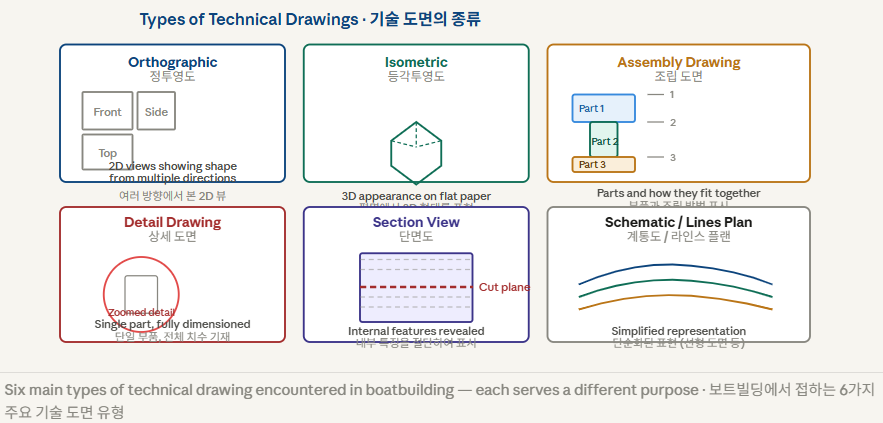
① Types of Technical Drawings · 기술 도면의 종류
🇬🇧 What is a technical drawing?
A technical drawing communicates exact information about shape, size, material, and construction using standardised conventions. Unlike a sketch, every lines and symbol on a technical drawing has a specific, agreed meaning. In Australia, drawings follow the AS 1100 standard (Australian Standard for Technical Drawing).
🇰🇷 기술도면이란?
기술 도면은 표준화된 관례를 사용하여 형태, 크기, 재료, 건조에 관한 정확한 정보를 전달한다. 스케치와 달리 기술도면의 모든 선과 기호는 특정하고 합의된 의미를 가진다. 호주에서는 도면이 AS 1100 표준(기술 도면 호주 표준)을 따른다.
② Line Types and Their Meanings · 선의 종류와 의미
🇬🇧 Why line types matter
In technical drawing, not all lines are equal. A thick continuous line means something completely different from a thin dashed line. Learning to read line types is the first skill — if you mistake a hidden line for a visible line, you will misread the shape of the object entirely.
🇰🇷 선의 종류가 중요한 이유
기술 도면에서 모든 선이 동일하지 않다. 굵은 연속선은 얇은 점선과 완전히 다른 의미를 가진다. 선의 종류를 읽는 것이 첫 번째 기술이다 — 숨은 선(hidden line)을 보이는 선으로 혼동하면 물체의 형태를 완전히 잘못 읽게 된다.

③ Orthographic Projection · 정투영도
🇬🇧 What is orthographic projection?
Orthographic projection is the standard method for showing a 3D object on a flat drawing. The object is projected onto a series of flat planes — think of it as shining a light directly at the object from each direction and tracing the shadow. Each view shows exactly one face of the object without any perspective distortion.
🇰🇷 정투영이란?
정투영은 3D 물체를 평면 도면에 표시하는 표준 방법이다. 물체를 일련의 평면에 투영한다 — 각 방향에서 빛을 물체에 직접 비춰 그림자를 추적하는 것처럼 생각하라. 각 뷰는 원근 왜곡 없이 물체의 정확히 한 면을 보여준다.
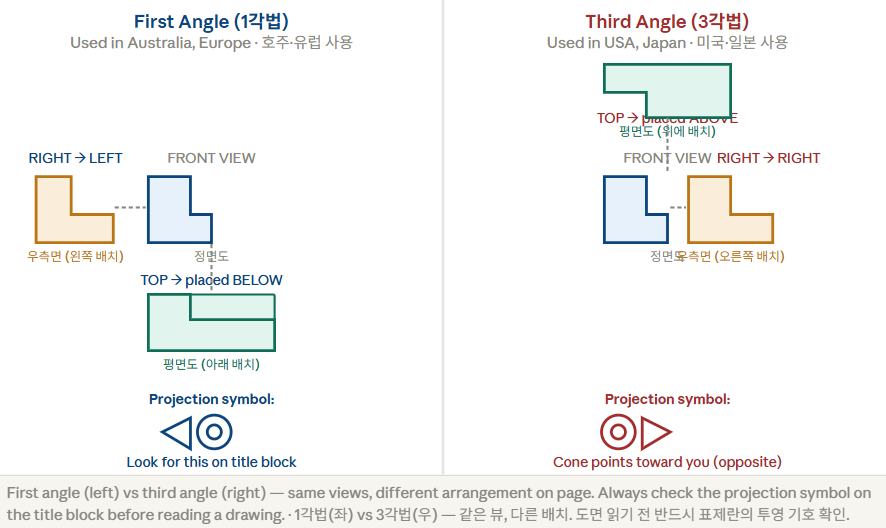
First Angle vs Third Angle Projection · 1각법 vs 3각법
This is one of the most important concepts in reading drawings — and one of the most commonly confused. Both methods show the same views; they just arrange them on the page differently. Australia generally uses first-angle projection, but you will encounter both in industry.
이것은 도면 읽기에서 가장 중요한 개념 중 하나이며, 가장 자주 혼동되는 것 중 하나이다. 두 방법 모두 같은 뷰를 보여주지만 페이지에 배열하는 방식이 다르다. 호주는 일반적으로 1각법(first angle)을 사용하지만 업계에서 둘 다 접하게 된다.
Reading a Three-View Drawing · 3뷰 도면 읽기

④ Section Views · 단면도
🇬🇧 Why section views exist
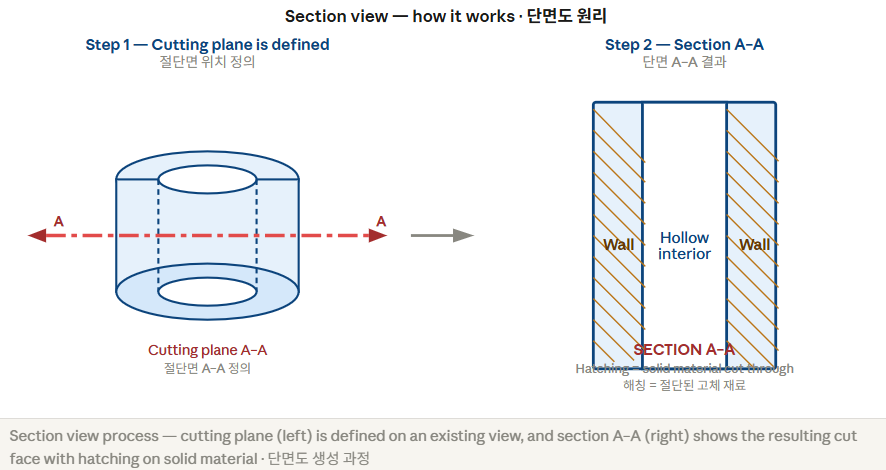
Some internal features of an object cannot be clearly shown with hidden (dashed) lines — they become too complex to read. A section view imagines that a cutting plane slices through the object, and then you look at the cut face. The cut material is shown with hatching (diagonal lines). Anything behind the cut plane remains visible.
🇰🇷 단면도가 존재하는 이유
물체의 일부 내부 특징은 숨은 선(점선)으로 명확하게 표시할 수 없다 — 너무 복잡해서 읽기 어려워진다. 단면도는 절단면이 물체를 가로로 잘라낸다고 상상하고, 절단면을 본다. 절단된 재료는 해칭(대각선)으로 표시된다.
⑤ Dimensions and Notation · 치수와 표기법
🇬🇧 What dimensions tell you
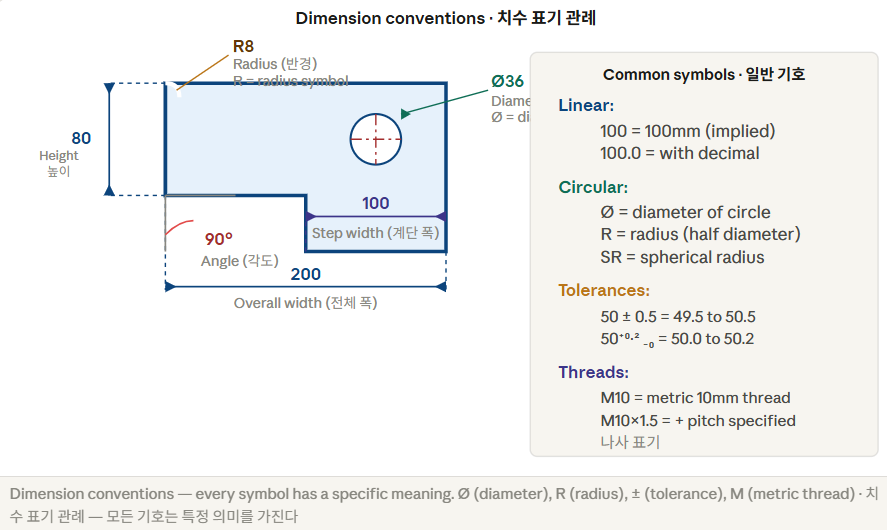
A drawing without dimensions is just a picture. Dimensions tell you the exact size of every feature — length, width, height, hole diameter, radius, angle. They must be read carefully: a missing decimal point or misread number can mean a part that doesn't fit, wasted material, or a structural failure.
🇰🇷 치수가 알려주는 것
치수 없는 도면은 그냥 그림이다. 치수는 모든 특징의 정확한 크기를 알려준다 — 길이, 폭, 높이, 구멍 직경, 반경, 각도. 주의 깊게 읽어야 한다: 소수점 누락이나 숫자 오독은 맞지 않는 부품, 재료 낭비, 구조적 실패로 이어질 수 있다.
⑥ Boatbuilding Drawings · 보트빌딩 도면
🇬🇧 Technical drawing applied to boatbuilding
Boatbuilding uses all the conventions above — plus some drawings unique to the field. The most important is the lines plan, which defines the three-dimensional shape of the hull on a flat sheet. Reading a lines plan is one of the most challenging skills in the trade — but once you understand the three views and how they relate, it becomes logical.
🇰🇷 보트빌딩에 적용되는 기술 도면
보트빌딩은 위의 모든 관례와 함께 이 분야에 고유한 도면을 사용한다. 가장 중요한 것은 라인스 플랜으로, 평면 위에 선체의 3차원 형태를 정의한다. 라인스 플랜 읽기는 업계에서 가장 도전적인 기술 중 하나이지만, 세 뷰와 그 관계를 이해하면 논리적으로 이해된다.
The Lines Plan · 라인스 플랜 (선도)

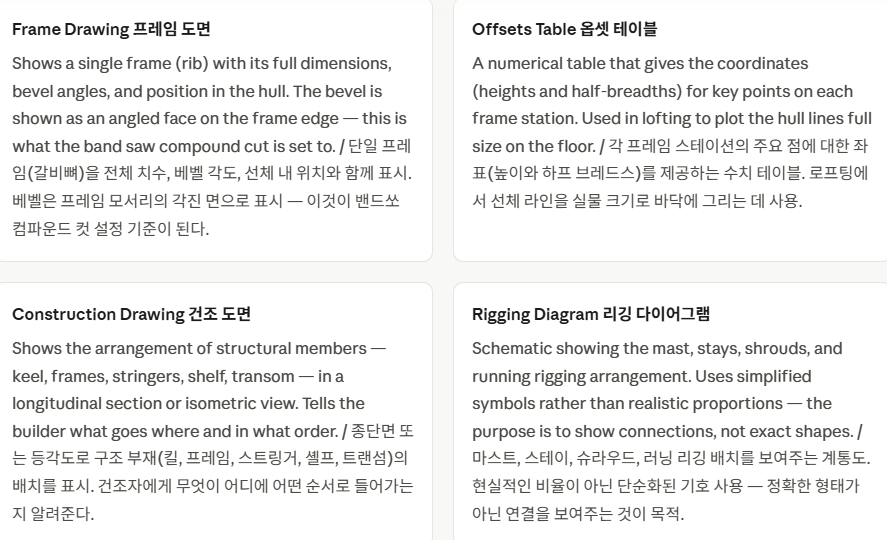
Other Common Boatbuilding Drawings · 기타 일반 보트빌딩 도면
⑦ Title Block and Drawing Standards · 표제란과 도면 표준
🇬🇧 Why the title block matters
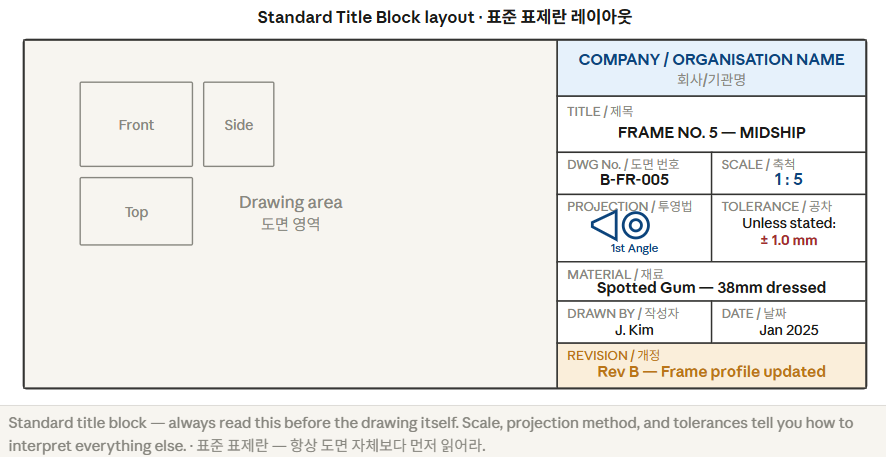
Before reading any drawing, read the title block first. It tells you everything you need to know to interpret the drawing correctly: scale, projection method, tolerances, material, revision number, and who drew it. Skipping the title block and diving straight into the drawing is a common source of errors.
🇰🇷 표제란이 중요한 이유
어떤 도면을 읽기 전에 먼저 표제란을 읽어라. 축척, 투영 방법, 공차, 재료, 개정 번호, 작성자 등 도면을 올바르게 해석하는 데 필요한 모든 것을 알려준다. 표제란을 건너뛰고 도면으로 바로 들어가는 것은 흔한 오류의 원인이다.
Key information in the title block · 표제란의 핵심 정보
| Field | What it tells you | 해석 |
| Scale | 1:1 = full size · 1:5 = 5× smaller than real · 5:1 = 5× larger than real (detail) | 1:1 실물 크기 · 1:5 실물의 5분의 1 · 5:1 확대 상세도 |
| Projection | First or third angle — determines which side each view appears on | 1각법 또는 3각법 — 각 뷰의 배치 방향 결정 |
| Tolerance | The permitted variation if no specific tolerance is stated on a dimension | 치수에 별도 공차가 없을 때 허용되는 변동 범위 |
| Material | What the part should be made from — timber species, grade, metal alloy | 부품의 재료 — 수종, 등급, 금속 합금 |
| Revision | Current version of the drawing — always use the latest revision. Old revisions cause costly errors. | 현재 도면 버전 — 항상 최신 개정판을 사용. 구 버전은 비용이 많이 드는 오류를 유발한다. |
| Drawing number | Unique identifier — used when ordering, referencing, or filing drawings | 고유 식별자 — 주문·참조·파일링 시 사용 |
'Marine Composites' 카테고리의 다른 글
| Review: MEM11011B 인력 부하 작업시 유의 사항 (1) | 2026.06.04 |
|---|---|
| Review: MEM09021B 곡선형 3차원 형상의 이해와 제작 (0) | 2026.06.03 |
| Review: MEM08011B 용제 및 기계적 방법을 이용한 표면 처리 (1) | 2026.06.01 |
| Review: MEM07001B 기계 및 장비 기본 유지관리 (0) | 2026.05.29 |
| Review: MEM04018B 목공 기계 운용 기초 (0) | 2026.05.26 |


