MEM04018B Perform general woodworking machine operations
General Woodworking Machine Operations
목공 기계 운용 기초
Eight core machines. From the rip saw to the drill press — how each one works, how to set it up safely, and what the critical checks are before, during, and after use. All study questions and answers included, in English and Korean.
총 8가지 핵심 목공 기계의 작동 원리와 안전한 세팅 방법, 그리고 작업 전·중·후 반드시 확인해야 할 핵심 사항들을 다룹니다. 모든 학습 문제와 해설은 영어와 한국어로 함께 수록되어 있습니다.
🇬🇧 About this unit
This unit covers the safe and correct operation of the core woodworking machines found in any boatbuilding workshop. Each machine is covered with a setup procedure, safe operation, and the key things to check before you start. The content is based on my TAFE studies and adapted for modern boatbuilding practice.
🇰🇷 이 챕터 소개
이 챕터는 보트빌딩 작업장에서 사용하는 핵심 목공 기계들의 안전하고 올바른 조작법을 다룬다. 각 기계의 세팅 절차, 안전한 조작, 시작 전 핵심 점검 사항을 포함한다. TAFE 수업을 바탕으로 현대 보트빌딩에 맞게 정리했다.
① Rip Saw (Circular Saw Bench)
립 쏘 / 원형 톱 테이블
Rips timber to width along the grain. A tungsten-tipped blade, correctly positioned riving knife, and a properly set crown guard are the three non-negotiables for safe operation. 나뭇결 방향으로 목재를 원하는 폭으로 켠다. 텅스텐 팁 블레이드, 올바르게 위치한 리빙 나이프, 크라운 가드 설정 — 이 세 가지가 안전 조작의 핵심이다.
Study Questions · 학습 문제 — Rip Saw
1. What is a rip saw used for, and how does its blade differ from other saw types?
EN
A rip saw cuts timber lengthwise — along the grain — to a required width. Its blade teeth are designed specifically for ripping: fewer, larger teeth with a positive rake angle that scoops material out efficiently along the grain direction.
KR
립쏘는 목재를 나뭇결 방향(길이 방향)으로 원하는 폭으로 켠다. 날의 이빨은 립 컷에 특화되어 — 크고 적은 이빨, 정방향의 레이크 각도로 결 방향으로 효율적으로 재료를 파낸다.
2. How should the rip fence be positioned relative to the blade, and why?
EN
The fence sits parallel to the blade on the operator's left. The distance from the fence face to the nearest blade tooth equals the desired cut width. A fence that is not parallel to the blade will cause the timber to bind or wander off the cut line.
KR
펜스는 작업자 왼쪽에서 블레이드와 평행하게 위치한다. 펜스 면에서 블레이드의 가장 가까운 이빨까지의 거리 = 원하는 재단 폭. 펜스가 블레이드와 평행하지 않으면 목재가 끼이거나 재단선에서 벗어난다.
3. Why is a tungsten carbide-tipped blade preferred over a standard steel blade for ripping?
EN
Tungsten carbide tips stay sharp significantly longer than high-speed steel — especially important when working with the hardwoods and resin-rich timbers common in boatbuilding. This means less frequent sharpening, more consistent cut quality, and less machine downtime.
KR
텅스텐 카바이드 팁은 고속도강보다 훨씬 오래 날카롭게 유지된다 — 보트빌딩에서 흔히 쓰이는 경재나 수지 함량이 높은 목재 작업 시 특히 중요하다. 연마 빈도 감소, 일정한 절단 품질, 가동 중단 시간 감소라는 장점이 있다.
4. What role does the riving knife play, and how should it be set?
EN
The riving knife sits directly behind the blade and keeps the kerf open as timber passes through, preventing the cut faces from closing back onto the blade — the main cause of kickback. It should be the same thickness as the blade plate and set no more than 8mm behind the blade tip.
KR
리빙 나이프는 블레이드 바로 뒤에 위치하며 목재가 통과할 때 커프를 벌려, 재단면이 블레이드로 다시 닫히는 것을 방지 — 킥백의 주원인을 막는다. 블레이드 플레이트와 동일한 두께로, 블레이드 끝에서 8mm 이하로 설정해야 한다.
5. List six things to check or prepare before starting a rip saw operation.
EN
1. Crown guard is correctly positioned over the blade. 2. Riving knife is correctly set and locked in place. 3. Fence is parallel to the blade and locked. 4. Blade is sharp with no missing or damaged teeth. 5. Anti-kickback pawls move freely and are engaged. 6. Work area and floor are clear of off-cuts and debris.
KR
1. 크라운 가드가 블레이드 위에 올바르게 위치. 2. 리빙 나이프가 올바르게 설정되고 잠겨 있음. 3. 펜스가 블레이드와 평행하게 잠겨 있음. 4. 블레이드가 날카롭고 이빨 결손·손상 없음. 5. 킥백 방지 폴이 자유롭게 움직이고 작동 중. 6. 작업 구역과 바닥에 잔재물·쓰레기 없음.
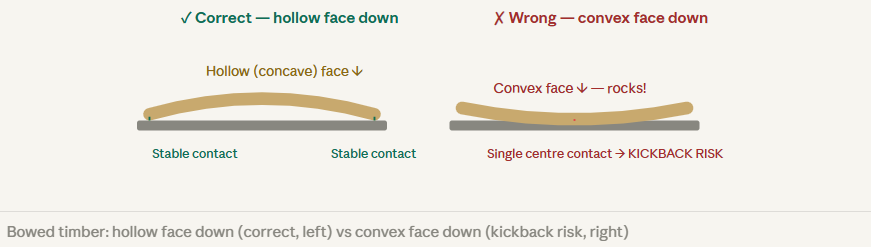
6. When ripping bowed or curved timber, how should it be placed on the table — and why?
EN
Always place thehollow (concave) face down. This gives two stable contact points at each end of the board. If the convex face goes down, the board rocks on its centre and can pivot into the blade, causing kickback.
KR
반드시오목한 면(hollow side)이 아래로 오도록 놓는다. 양 끝에 두 개의 안정적인 접촉점이 생긴다. 볼록한 면이 아래로 오면 중앙에서 흔들려 블레이드 방향으로 피벗될 수 있어 킥백이 발생한다.
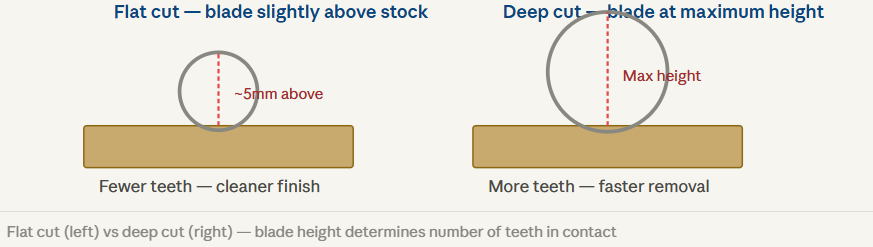
7. What is the difference between a "flat cut" and a "deep cut" on a circular saw bench?
EN
Flat cut:Blade raised only slightly above the stock — fewer teeth are in contact at once, producing a cleaner cut but at a slower rate. Preferred for valuable or thin timber. Deep cut:Blade raised to maximum height — more teeth engaged simultaneously, removing material faster. Standard for structural ripping.
KR
플랫 컷:날을 목재 위로 약간만 올림 — 적은 이빨이 동시에 접촉, 더 깨끗하지만 느린 절단. 고가 목재나 얇은 목재에 적합. 딥 컷:날을 최대 높이로 올림 — 더 많은 이빨이 동시 접촉, 빠른 재료 제거. 구조재 립 컷의 표준.
8. When and why must a push stick be used on the rip saw?
EN
A push stick is required whenever the rip width is less than 150mm, and on the final 300mm of any rip cut. It keeps the operator's hands safely away from the blade and allows controlled forward pressure without the risk of fingers nearing the blade.
KR
립 폭이 150mm 미만일 때와 모든 립 컷의 마지막 300mm 구간에서 반드시 사용한다. 작업자의 손을 블레이드에서 안전하게 유지하고 손가락이 블레이드에 가까워지는 위험 없이 제어된 전진 압력을 가능하게 한다.
9. How is the crown guard correctly set before making a cut?
EN
Lower the crown guard until it rests lightly on top of the material — approximately 3mm clearance above the stock surface. It must cover the full blade width and should not impede the feed of the material, but must prevent any contact with the blade from above.
KR
크라운 가드를 재료 위에 가볍게 안착될 때까지 내린다 — 목재 표면 위 약 3mm 간격. 블레이드 전폭을 덮어야 하며, 재료 이송을 방해하지 않으면서 위에서의 블레이드 접촉을 방지해야 한다.
10. Where should the operator stand in relation to the blade during a rip cut, and why?
EN
Stand slightly to one side —never directly in line with the blade. Kickback projects material back in a straight line directly toward where the operator is standing. Positioning to the side keeps the operator completely out of that path.
KR
옆에 약간 비켜 선다 —절대 블레이드와 일직선상에 서지 말 것. 킥백은 재료를 블레이드 일직선 방향으로 튕겨낸다. 옆에 서면 킥백 경로에서 완전히 벗어난다.
11. What is the role of the person at the outfeed end when ripping long timber?
EN
The outfeed person supports the material as it exits the blade, keeping it level with the table surface. They mustfollowthe material's movement only — never pull, push, or guide it. Pulling would cause the timber to bind on the blade; pushing would interfere with the operator's feed rate.
KR
아웃피드 작업자는 블레이드를 빠져나오는 목재가 테이블 표면과 수평을 유지하도록 받쳐준다. 재료의 움직임을따르기만— 절대 당기거나, 밀거나, 유도하지 않는다. 당기면 블레이드에 끼임, 밀면 작업자의 이송 속도를 방해한다.
② Drop Saw (Compound Mitre Saw)
드롭 쏘 / 복합 마이터 쏘
Used for crosscutting to precise lengths and for cutting angled and compound-angled faces. The blade swings horizontally (mitre) and tilts (bevel), allowing any combination of angle cuts. 정밀한 길이의 크로스컷과 각도·복합 각도면 절단에 사용. 블레이드가 수평(마이터)과 기울기(베벨) 두 방향으로 조합되어 어떤 각도 컷도 가능하다.
Study Questions · 학습 문제 — Drop Saw
1. List six important safety practices that apply specifically to operating a drop saw.
EN
1. Allow the blade to reach full speed before starting the cut. 2. Keep both hands well clear of the cutting line at all times. 3. Secure the stock firmly against the fence — clamp if possible. 4. Wait for the blade to come to a complete stop before raising the head. 5. Never make cuts without the fence or a clamp in place. 6. Check the guard returns automatically after each cut before continuing.
KR
1. 절단 시작 전 블레이드가 완전히 회전 속도에 도달할 때까지 대기. 2. 절단선에서 양손을 항상 완전히 떨어진 상태로 유지. 3. 목재를 펜스에 단단히 고정 — 가능하면 클램프 사용. 4. 헤드를 올리기 전 블레이드가 완전히 정지할 때까지 대기. 5. 펜스나 클램프 없이 절단 금지. 6. 계속하기 전 매 절단 후 가드가 자동 복귀하는지 확인.
2. Describe the difference between rough-docking timber to length and squaring it to a finished length.
EN
Rough docking:Cutting timber to approximate lengths for easier handling — typically 50–100mm over the required finished length. No precision required at this stage. Squaring to finished length:A precise two-step process — first cut removes the damaged or uneven end to create a true square reference, then a stop is set, and all pieces are cut to the exact final dimension from that reference.
KR
러프 도킹:취급 편의를 위해 목재를 대략적인 길이로 재단 — 보통 마감 치수보다 50–100 mm 길게. 이 단계에서 정밀도는 불필요. 스퀘어링 투 피니시드 렝스:정밀한 2단계 작업 — 첫 컷으로 손상되거나 고르지 않은 끝단을 제거해 직각 기준면 형성, 그 후 스톱을 설정하여 모든 조각을 해당 기준에서 정확한 최종 치수로 재단.
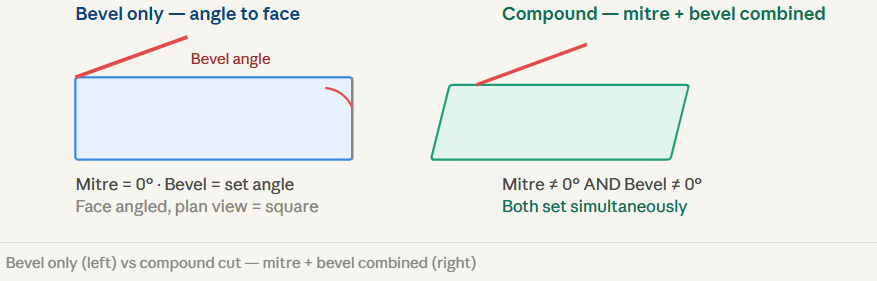
3. Using diagrams, describe what happens to the cut face when only the bevel is set, and when both the mitre and bevel are set at the same time.
EN
Angle to face (bevel only):The blade is tilted — the cut face is angled across the width of the timber but the cut runs square across the plan view. Mitre is at 0°. Compound cut (mitre + bevel):Both the horizontal swing and the blade tilt are set simultaneously. The cut face is angled in both plan and elevation at once — as found on raking mouldings and boat frame ends that carry both a run bevel and a cross bevel.
KR
각도 페이스(베벨만):블레이드를 기울여 재단 — 재단면이 목재 폭을 가로질러 각도를 가지지만 평면도에서는 직각으로 절단. 마이터 0°. 컴파운드 컷(마이터+베벨 동시):수평 스윙과 블레이드 기울기를 동시에 설정. 재단면이 평면과 입면 양쪽에서 동시에 각도를 가짐 — 경사 몰딩이나 런 베벨과 크로스 베벨을 모두 가진 선박 프레임 끝단에서 볼 수 있다.
③ Scroll Band Saw
스크롤 밴드 쏘
The only machine that cuts curves as naturally as straight lines. A continuous blade runs between two wheels, cutting on the downstroke. Blade selection, correct tension, and tracking are the three key setup steps. 직선만큼 자연스럽게 곡선을 재단하는 유일한 기계. 두 휠 사이를 순환하는 연속 블레이드가 하향 스트로크에서 절단한다. 블레이드 선택, 올바른 장력, 트래킹 — 세 가지 핵심 세팅.
Study Questions · 학습 문제 — Band Saw
1. What types of cuts can a scroll band saw perform that other saws cannot?
EN
The band saw can cut tight curves and irregular profiles that no circular saw can follow. It can also resaw wide, thick timber into thinner boards, cut circles, and make relief cuts to allow waste to fall away from curved work. The narrow blade is the key — it can turn mid-cut.
KR
밴드쏘는 원형 쏘로는 불가능한 좁은 곡선과 불규칙한 프로파일을 절단할 수 있다. 넓고 두꺼운 목재를 얇은 판으로 켜기(resaw), 원형 컷, 잔재가 떨어지도록 하는 릴리프 컷도 가능하다. 좁은 블레이드가 핵심 — 절단 중간에 방향 전환이 가능하다.
2. What is the fence on a band saw used for, and what adjustment is often needed when using it?
EN
The fence guides the stock for straight rip cuts parallel to the edge. Because band saw blades naturally drift slightly off the fence line, the fence must be angled slightly to compensate for this drift — set by making a test cut and adjusting until the blade tracks true along the fence.
KR
펜스는 목재 가장자리에 평행한 직선 립 컷을 위해 목재를 가이드한다. 밴드쏘 블레이드는 자연적으로 펜스 라인에서 약간 벗어나는 "드리프트"가 있으므로, 펜스를 이를 보정하기 위해 약간 각도를 조정해야 한다 — 테스트 컷으로 확인하고 블레이드가 올바르게 주행할 때까지 조정한다.
3. What three factors should guide the selection of a band saw blade, and how does each affect the cut?
EN
1. Width:Wide blades (19–25mm) for straight and resaw work — they resist deflection. Narrow blades (6–10mm) for tight curves — they can turn radius cuts, a wide blade cannot. 2. TPI:Low TPI for thick or soft timber — larger gullets clear chips faster. High TPI for thin or hard material — more teeth produce a finer cut. 3. Tooth pattern:Regular for general work; skip tooth for green/wet timber; hook tooth for fast cutting of thick hardwood.
KR
1. 폭:넓은 날(19–25mm)은 직선·리쏘 굴곡 작업에 강하다. 좁은 날(6–10mm)은 좁은 곡선 — 넓은 날이 못 도는 반경 컷이 가능하다. 2. TPI:낮은 TPI는 두껍고 연한 목재 — 큰 걸렛(gullet)이 칩을 빠르게 배출. 높은 TPI는 얇거나 단단한 재료 — 더 많은 이빨이 미세한 절단을 생산. 3. 이빨 패턴:레귤러(일반 작업), 스킵(생목/젖은 목재), 훅(두꺼운 경재 고속 절단).
4. Name the three main components of a band saw guide assembly and describe what each one does.
EN
Thrust bearing (rear):A roller bearing directly behind the blade that absorbs the backward force of the workpiece pushing against the blade during a cut. Side guides (×2):Positioned 0.3mm each side of the blade — prevent it from twisting sideways under lateral cutting forces. Guide post:The vertical assembly holding all guide parts — must be set 3–6mm above the workpiece to minimise unsupported blade length.
KR
추력 베어링(후방):블레이드 바로 뒤의 롤러 베어링 — 가공물이 절단 중 블레이드를 뒤로 미는 힘을 흡수. 사이드 가이드(×2):블레이드 양쪽 0.3mm 위치 — 측면 절단력에 의한 블레이드 비틀림 방지. 가이드 포스트:모든 가이드 부품을 고정하는 수직 조립체 — 지지되지 않은 블레이드 길이를 최소화하기 위해 가공물 위 3–6 mm로 설정.
5. Which wheel drives the band saw blade, and which one is used to tension it?
EN
Thelower wheelis the drive wheel — directly connected to the motor. Theupper wheelis the idler/tension wheel — raising it applies tension to the blade.
KR
아래 휠이 구동 휠 — 모터에 직접 연결.위 휠이 아이들러/장력 휠 — 올리면 블레이드에 장력이 적용된다.
6. How is correct blade tension set on a band saw, and how can it be verified?
EN
Raise the upper (idler) wheel using the tension adjustment handle. Use the machine's tension scale as the starting point, then verify: apply light sideways finger pressure to the blade — it should deflect no more than 6mm. Under-tensioned blades wander; over-tensioned blades fatigue and break prematurely.
KR
장력 조절 핸들로 위(아이들러) 휠을 올린다. 기계의 장력 눈금을 시작점으로 사용한 후 확인: 가벼운 측면 손가락 압력을 블레이드에 가한다 — 6mm 이하로 굴곡되어야 한다. 장력 부족: 블레이드가 흔들림; 과도한 장력: 블레이드 피로로 조기 파단.
7. What does "tracking" mean on a band saw, and what happens if it is not set correctly?
EN
Tracking adjusts the tilt of the upper wheel so the blade runs centred on both wheel tyres. If tracking is off, the blade migrates sideways and eventually comes off the wheels, which is dangerous and damages the blade. Set by running the machine slowly with the door open and adjusting the tilt knob until the blade centres itself.
KR
트래킹은 블레이드가 두 휠 타이어의 중앙에서 주행하도록 위 휠의 기울기를 조절한다. 트래킹이 맞지 않으면 블레이드가 측면으로 이동하다 결국 휠에서 벗겨진다 — 위험하고 블레이드가 손상된다. 도어를 열고 저속으로 돌리면서 블레이드가 중앙에 오도록 틸트 노브를 조절하여 설정한다.
8. What six things should be checked before starting the band saw?
EN
1. Blade tension — deflection test. 2. Blade tracking — centred on both wheels. 3. Upper guide set 3–6mm above workpiece height. 4. Side guides set 0.3mm either side of the blade. 5. Blade inspected for cracks, missing teeth, or weld defects. 6. Blade guard and door closed and latched.
KR
1. 블레이드 장력 — 굴곡 테스트. 2. 블레이드 트래킹 — 양 휠 중앙. 3. 상부 가이드를 가공물 위 3–6 mm로 설정. 4. 사이드 가이드를 블레이드 양쪽 0.3mm로 설정. 5. 블레이드 균열, 이빨 결손, 용접 결함 검사. 6. 블레이드 가드·도어 닫힘 및 잠금 확인.
9. How should bowed timber be oriented when cutting on the band saw?
EN
Place thehollow (concave) face down— the same principle as the rip saw. An alternative on the band saw is to make a relief cut first to create a flat reference surface, then recut with that flat face down against the table.
KR
오목한 면(hollow side)이 아래로 오도록 놓는다 — 립 쏘와 동일한 원리. 밴드쏘에서는 대안으로 먼저 릴리프 컷으로 평평한 기준면을 만든 후, 그 평면을 아래로 하고 재절단하는 방법도 있다.
10. Describe the correct technique for ripping material to width on a band saw.
EN
Adjust the fence to compensate for blade drift. Feed the stock steadily — one hand guiding against the fence, the other pushing forward. Keep feed speed consistent; pausing causes burn marks. Use a push stick for the last 100mm. Never slow down or stop mid-cut.
KR
블레이드 드리프트를 보정하여 펜스를 설정한다. 한 손은 펜스에 가이드하고, 다른 손은 앞으로 밀며 꾸준히 이송. 이송 속도를 일정하게 유지 — 멈추면 번 마크 발생. 마지막 100mm는 푸시 스틱 사용. 절단 중간에 속도를 늦추거나 멈추지 말 것.
11. What jig is needed to safely rip round stock, and why can't it be done freehand?
EN
A V-block jig clamped to the table is required. The round stock sits in the V-groove, which prevents it from rotating. Freehand ripping of round material is extremely dangerous — without the V-block, the blade catches the stock and spins it violently.
KR
테이블에 클램프된 V블록 지그가 필요하다. 원형 목재가 V홈에 안착되어 회전을 방지한다. 원형 목재의 자유 손 립 컷은 매우 위험하다 — V블록 없이는 블레이드가 목재를 잡아 격렬하게 회전시킨다.
12. What are relief cuts, and what is the correct procedure if you need to reverse the blade out of a cut?
EN
Relief cuts:Straight cuts made toward (but stopping before) a curve to allow waste sections to fall away, preventing the blade from being trapped in a tight radius. Reversing out:Neverreverse a running blade out of a cut. Switch the machine off, wait for the blade to fully stop, then carefully back the workpiece out.
KR
릴리프 컷:곡선을 향해(곡선 직전에서 멈추는) 직선 컷을 먼저 해 잔재 조각이 떨어지도록 하여 좁은 반경에서 블레이드가 끼이는 것을 방지. 역방향 빼내기:절대가동 중인 블레이드를 역방향으로 빼지 말 것. 기계를 끄고 블레이드가 완전히 정지한 후 가공물을 조심스럽게 역방향으로 뺀다.
13. Give an example of a boatbuilding component that requires a compound cut on the band saw, and explain why.
EN
Boat frames (ribs) are the classic example. The frame face must contact the planking perfectly flat — but the planking angle changes both along the hull (run bevel) and across the hull section (cross bevel). This means the frame edge must be cut with both angles applied simultaneously: a compound band saw cut.
KR
선박 프레임(갈비뼈)이 대표적인 예다. 프레임 면이 플랭킹에 완벽하게 평평하게 접촉해야 하지만 — 플랭킹 각도가 선체를 따라(런 베벨)와 선체 단면을 가로질러(크로스 베벨) 모두 변한다. 따라서 프레임 모서리는 두 각도를 동시에 적용한 컴파운드 밴드쏘 컷으로 절단해야 한다.
④ Panel Saw
패널 쏘
Designed for cutting full sheet materials — marine ply, MDF, and hardboard — accurately to size. In boatbuilding, every bulkhead, sole panel, and structural sheet starts on the panel saw. 전체 판재 — 마린 플라이, MDF, 하드보드 — 를 정밀하게 재단하는 기계. 보트빌딩에서 모든 벌크헤드, 솔 패널, 구조 판재가 패널 쏘에서 시작된다.
Study Questions · 학습 문제 — Panel Saw
1. What is the panel saw designed to do, and how does it differ from a standard rip saw bench?
EN
The panel saw is designed to cut large sheet materials (plywood, MDF, particleboard) accurately to both width and length. Unlike a standard rip saw bench, where the material moves past a fixed saw, the panel saw uses a roller table to support sheets and a sliding saw head that travels across the material for crosscuts.
KR
패널 쏘는 대형 판재(합판, MDF, 파티클보드)를 폭과 길이 모두 정밀하게 재단하도록 설계됐다. 재료가 고정된 쏘를 지나가는 일반 립 쏘 벤치와 달리, 패널 쏘는 판재를 지지하는 롤러 테이블과 크로스컷을 위해 재료를 가로질러 이동하는 슬라이딩 쏘 헤드를 사용한다.
2. How do the blade teeth for softwood and hardwood panel cutting differ in shape, and why?
EN
Softwood:Fewer, larger teeth with a positive hook angle — removes material quickly as softwood fibres are easy to sever.Hardwood:More teeth with a neutral or negative hook angle and alternate top bevel (ATB) — produces a cleaner cut in dense grain and reduces tearout on the veneer face of plywood.
KR
연재:더 크고 적은 이빨, 양의 훅 각도 — 연재 섬유가 쉽게 끊어지므로 빠른 재료 제거.경재:더 많은 이빨, 중립 또는 음의 훅 각도 + ATB(교대 상단 베벨) — 밀집된 나뭇결에서 더 깨끗한 절단, 합판 베니어 면의 뜯김 감소.
3. What is the ripping fence on a panel saw used for, and how is it set?
EN
The ripping fence guides the sheet at a fixed, parallel distance from the blade to produce a consistent width across the full sheet length. It is adjusted by sliding it to the required dimension on the scale, then locking it securely before any cut is made.
KR
립핑 펜스는 판재 전체 길이에 걸쳐 일정한 폭을 생산하기 위해 블레이드에서 고정된 평행거리로 판재를 가이드한다. 눈금에서 필요한 치수로 슬라이드한 후 절단 전에 단단히 잠근다.
4. How does the movable crown guard protect the operator on a panel saw?
EN
The crown guard covers the top of the blade and travels with the saw head. It is spring-loaded to rest on top of the material, lifting only enough for the blade to pass through — preventing any accidental contact with the blade from above during the cut.
KR
크라운 가드는 블레이드 상단을 덮고 쏘 헤드와 함께 이동한다. 스프링 하중으로 재료 위에 안착되며, 블레이드가 통과할 만큼만 올라간다 — 절단 중 위에서의 블레이드와의 우발적 접촉을 방지한다.
5. On which side of the ripping fence should the sheet be placed, and why?
EN
The sheet goes on theleft sideof the fence — between the fence and the operator. The waste piece exits to the right, away from the operator. This keeps the larger, heavier piece under controlled guidance while the offcut falls clear.
KR
판재는 펜스의왼쪽(펜스와 작업자 사이)에 놓인다. 잔재는 오른쪽으로 빠져나가 작업자에게서 멀어진다. 더 크고 무거운 조각이 제어된 가이드 하에 유지되는 동안 잔재가 떨어져 나간다.
6. Where is the blade height adjustment (rise and fall) control located, and why is this position important?
EN
It is located at the front of the saw head or the operator's console — accessible without reaching near the blade. This allows blade depth to be safely adjusted with the machine stopped, without placing hands anywhere near the cutting zone.
KR
쏘 헤드 전면 또는 작업자 콘솔에 위치 — 블레이드 근처에 손을 뻗지 않고 접근 가능하다. 이 위치 덕분에 기계를 멈춘 상태에서 절단 구역 근처에 손을 가져가지 않고 날 깊이를 안전하게 조정할 수 있다.
7. List six pre-operational safety checks for the panel saw.
EN
1. All guards in place and working correctly. 2. Blade is the correct type and sharp for the material. 3. Ripping fence locked at the required setting. 4. Roller tables at the correct height to support sheets fully. 5. Floor around the machine clear of off-cuts and obstacles. 6. Dust extraction system running.
KR
1. 모든 가드 위치 및 작동 상태 확인. 2. 재료에 적합하고 날카로운 블레이드인지 확인. 3. 립핑 펜스가 필요한 설정으로 잠겨 있음. 4. 판재를 완전히 지지하는 롤러 테이블의 높이를 확인. 5. 기계 주변 바닥의 잔재물·장애물 제거. 6. 집진 시스템 가동 확인.
8. List four personal safety habits the operator should follow when using the panel saw.
EN
1. Safety glasses and hearing protection are worn at all times. 2. No loose clothing, jewellery, or gloves near the blade. 3. Stand to the side — never directly in line with the blade. 4. Use roller stands or a second person for large sheets — never overreach across a running blade.
KR
1. 항상 안전안경과 청력 보호구를 착용. 2. 블레이드 근처에서 헐렁한 의복, 장신구, 장갑 금지. 3. 블레이드와 일직선이 아닌 옆에 서기. 4. 큰 판재는 롤러 스탠드나 보조 작업자를 사용 — 가동 중인 블레이드 너머로 절대 손 뻗지 말 것.
9. What is the recommended sequence for breaking a full sheet down into smaller panels?
EN
Always rip to width first, then crosscut to length. Large sheets are more stable and controllable for rip cuts. Crosscutting a full 2400mm sheet lengthwise is awkward and unsafe; ripping it to a narrower width first makes subsequent crosscuts manageable. Use a stop block for repeating cuts to the same length.
KR
항상 립 컷을 먼저 하고 그다음 길이 크로스 컷을 한다. 큰 판재는 립 컷에서 더 안정적이고 제어하기 쉽다. 전체 2400mm 판재를 길이 방향으로 크로스컷하는 것은 어색하고 위험하다; 먼저 폭을 줄이면 이후 크로스컷이 관리하기 쉬워진다. 같은 길이 반복 재단에는 스톱 블록을 사용.
10. How does the state of the work area and the machine affect the quality and safety of panel saw operations?
EN
Off-cuts on the floor create trip hazards and can be kicked into the blade path. Sawdust build-up on roller tables causes sheets to slide unevenly, producing inaccurate cuts. A clean, well-organised workspace directly improves both safety and cut accuracy — it is not optional.
KR
바닥의 잔재물은 넘어짐 위험을 만들고 블레이드 경로로 차일 수 있다. 롤러 테이블 위 톱밥이 쌓이면 판재가 고르지 않게 미끄러져 부정확한 재단을 낳는다. 청결하고 잘 정리된 작업 공간은 안전과 재단 정밀도를 직접적으로 향상시킨다.
11. What is meant by cutting multiple sheets at once, and what precaution is essential?
EN
Multiple cutting means stacking two or more sheets together and cutting them in a single pass — saving time when identical panels are needed. The stack must be securely clamped or taped together before cutting. If the sheets shift during the cut, the results will be inaccurate, and the blade may bind.
KR
멀티플 컷팅은 두 장 이상의 판재를 겹쳐 한 번에 재단하는 것 — 동일한 패널이 여러 장 필요할 때 시간 절약. 절단 전 스택을 반드시 클램프 또는 테이프로 단단히 고정해야 한다. 절단 중 판재가 이동하면 부정확한 결과와 블레이드 끼임이 발생한다.
⑤ Surface Planer (Jointer)
서페이스 플레이너 / 조인터
Creates the flat face and square edge — the two reference surfaces from which all other dimensions are taken. Always the first machine used on rough-sawn timber, before thicknessing. 평평한 면과 직각 모서리 — 모든 치수가 여기서 기준을 취하는 두 기준면을 만든다. 제재목에서 항상 시크니싱 전에 가장 먼저 사용하는 기계.
Study Questions · 학습 문제 — Surface Planer
1. What does a surface planer produce, and why does all subsequent dimensioning depend on it?
EN
The surface planer produces one flat, true face and one straight, square edge on rough-sawn timber. These two surfaces become the reference from which all subsequent dimensions — thickness, width, length — are accurately measured. Without them, all other cuts are measuring from an unreliable base.
KR
서페이스 플레이너는 제재목에 하나의 평평하고 올바른 면과 하나의 직선·직각 모서리를 만든다. 이 두 면이 두께, 폭, 길이 등 이후 모든 치수를 정확하게 측정하는 기준이 된다. 이것 없이는 모든 후속 재단이 신뢰할 수 없는 기준에서 측정하는 것이다.
2. Identify the two tables on a surface planer and describe the specific role of each.
EN
Infeed table:Where timber is placed before cutting. Set lower than the outfeed table by the depth of cut (0.5–2mm) — this controls how much material is removed per pass. Outfeed table:Set level with the top of the cutter arc — this is the precision datum. The freshly planed surface exits onto this table; if the table is correctly set, the planed face lies perfectly flat on it.
KR
인피드 테이블:절단 전 목재가 놓이는 곳. 절삭 깊이(0.5–2mm)만큼 아웃피드 테이블보다 낮게 설정 — 1회 패스당 제거되는 재료량을 조절한다. 아웃피드 테이블:커터 호의 정점과 수평으로 설정 — 정밀 기준(datum). 새로 평삭된 표면이 이 테이블 위로 빠져나온다; 테이블이 올바르게 설정됐으면 평삭면이 그 위에 완벽하게 평평하게 안착된다.
3. What is the rebate table (rebate ledge) used for on a surface planer?
EN
The rebate table is a lower, narrower extension of the infeed table beside the fence. It exposes the full width of the cutter block, allowing stepped rebates to be cut along the edge of timber — used in boatbuilding for keel rabbets, housing joints, and lap joints in structural members.
KR
래빗 테이블은 인피드 테이블 옆 펜스 옆의 낮고 좁은 연장 부분이다. 커터 블록의 전폭을 노출시켜 목재 모서리를 따라 단차 래빗을 가공할 수 있게 한다 — 보트빌딩에서 킬 래빗, 하우징 접합, 구조 부재의 랩 조인트에 사용된다.
4. What is the specific purpose of the fence on a surface planer?
EN
The fence provides a vertical reference face that the timber is held against when dressing the edge — ensuring the edge is cut square (or at a set angle) to the dressed face. It can also be tilted for chamfer cuts at any required angle.
KR
펜스는 모서리를 드레싱할 때 목재가 기대는 수직 기준면을 제공 — 모서리가 드레싱된 면에 대해 직각(또는 설정 각도)으로 절삭되도록 한다. 필요한 각도의 챔퍼 컷을 위해 기울일 수도 있다.
5. Identify two guard types used on a surface planer and describe how each protects the operator.
EN
Bridge guard:Spans the cutter block in front of the fence. Spring-loaded to rest on the timber surface — it exposes only the amount of cutter needed for the cut and covers the rest. Shaw guard (side guard):Fixed to the fence side of the cutter block — covers the portion beside the fence, protecting the hand holding the timber against the fence from contact with the cutter.
KR
브리지 가드:펜스 앞의 커터 블록을 가로지른다. 스프링 하중으로 목재 표면에 안착 — 컷에 필요한 만큼의 커터만 노출하고 나머지를 덮는다. 쇼 가드(사이드 가드):커터 블록의 펜스 쪽에 고정 — 펜스 옆 부분을 덮어, 펜스에 목재를 대고 있는 손이 커터와 접촉하는 것을 보호한다.
6. List six things to verify before starting a surface planer.
EN
1. Bridge guard and shaw guard are correctly positioned. 2. Cutter knives are sharp and set to equal height. 3. Outfeed table level with cutter arc. 4. Fence locked at the correct angle (90° for face edge work). 5. Cutter block bolts fully tightened. 6. Tables are clear of debris before starting.
KR
1. 브리지 가드와 쇼 가드를 올바르게 위치. 2. 커터 날을 날카롭고 동일한 높이로 설정. 3. 아웃피드 테이블이 커터 호와 수평. 4. 펜스가 올바른 각도로 잠겨 있음(페이스 엣지 작업에서는 90°). 5. 커터 블록 볼트 완전히 조여짐. 6. 시작 전 테이블의 잔재물 제거.
7. List six safety rules to follow while operating the surface planer.
EN
1. Keep fingers flat on top of the timber — never let them curl toward the cutter. 2. Use push blocks for any piece shorter than 300mm. 3. Never dress end grain on a surface planer. 4. Always feed in the correct grain direction. 5. Do not leave the machine running unattended. 6. Take light cuts (max 2–3mm per pass) — never force the material.
KR
1. 손가락을 목재 위에 평평하게 유지 — 절대 커터 방향으로 구부리지 말 것. 2. 300 mm 미만의 모든 조각에 푸시 블록을 사용. 3. 서페이스 플레이너에서 마구리(end grain) 드레싱 절대 금지. 4. 항상 올바른 나뭇결 방향으로 이송. 5. 기계를 켜 둔 채 자리를 비우지 말 것. 6. 가벼운 절삭(1회 패스 최대 2–3mm) — 절대 재료를 강제로 밀어넣지 말 것.
8. Why does grain direction matter when using a surface planer, and how do you identify the correct feed direction?
EN
Planing against the grain causes the cutter to dig under and lift wood fibres — producing tearout and a rough surface. Planing with the grain means the cutter slices cleanly along rising fibres. To identify the correct direction, look at the side face of the timber and feed it so the grain lines angle toward the infeed end — the cutter then "peels" with the grain, not against it.
KR
결 반대 방향으로 대패질하면 커터가 목재 섬유 아래로 파고들어 들어올려 — 뜯김과 거친 표면을 만든다. 결 방향으로 대패질하면 커터가 올라가는 섬유를 따라 깨끗하게 자른다. 올바른 방향을 찾으려면 목재 측면을 보고 나뭇결 선이 인피드 끝 방향으로 기울어지도록 이송한다 — 커터가 결을 거스르지 않고 함께 "벗겨낸다".
9. Describe the correct sequence for dressing a face and then a face edge on the surface planer.
EN
Face:Place the most nearly flat side down. Make light passes until the full face is clean and flat. Mark with a face mark (∫). Face edge:Place the face-marked side firmly against the fence. Make light passes until the edge is straight and square to the face. Mark with a face-edge mark. These two surfaces are the only reference used for all subsequent work.
KR
면 드레싱:가장 평평한 쪽을 아래로 놓는다. 전체 면이 깨끗하고 평평해질 때까지 가벼운 패스 반복. 페이스 마크(∫) 표시. 페이스 엣지 드레싱:페이스 마크된 면을 펜스에 단단히 밀착. 모서리가 면에 대해 직선·직각이 될 때까지 가벼운 패스 반복. 페이스 엣지 마크 표시. 이 두 기준 면에서만 이후 모든 작업의 치수를 취한다.
10. How do you determine the shortest piece of timber that can safely be dressed on a surface planer?
EN
The minimum safe length equals the distance between the infeed and outfeed tables — the material must be in contact with both tables simultaneously at all times during the cut. Material shorter than this span cannot be supported and controlled safely. In practice, 300mm is the common minimum; shorter pieces require push blocks and special jigs.
KR
최소 안전 길이는 인피드와 아웃피드 테이블 사이의 거리와 같다 — 절삭 중 재료가 항상 두 테이블에 동시에 닿아 있어야 한다. 이 거리보다 짧은 재료는 안전하게 지지·제어할 수 없다. 실제로는 300mm가 일반적인 최소값; 더 짧은 조각은 푸시 블록과 특수 지그가 필요하다.
11. What is a push block, and how does it differ from a push stick in a surface planer context?
EN
A push block applies both downward pressure and forward force on the timber simultaneously — essential on the surface planer, where the cutter can lift the stock if downward pressure is lost. A push stick only provides forward force, which is insufficient for safe planing. Push blocks are used for all short or narrow pieces on the surface planer.
KR
푸시 블록은 목재에 아래 방향 압력과 전진 힘을 동시에 가한다 — 아래 방향 압력이 사라지면 커터가 목재를 들어올릴 수 있는 서페이스 플레이너에서 필수다. 푸시 스틱은 전진 힘만 제공하므로 안전한 플레이닝에 불충분하다. 푸시 블록은 서페이스 플레이너에서 짧거나 좁은 모든 조각에 사용된다.
12. Describe how to dress bowed timber and twisted timber correctly on the surface planer.
EN
Bowed timber:Place the hollow (concave) face down — two stable contact points at each end. Take very light passes; the bow is progressively removed until the face reads flat. Once flat, flip and thicknesser. Twisted timber:Use winding sticks to identify the high diagonal corners. Place the two low corners on the table and take light passes, focusing on removing the high corners. Continue until winding sticks show no twist, then proceed to thicknessing.
KR
휜 목재:오목한 면이 아래로 오도록 놓는다 — 양 끝에 두 개의 안정적인 접촉점. 매우 가벼운 패스를 반복; 면이 평평하게 읽힐 때까지 점진적으로 휨이 제거된다. 평평해지면 뒤집어 시크니서로. 비틀린 목재:와인딩 스틱으로 높은 대각선 모서리를 식별. 낮은 두 모서리를 테이블에 오도록 놓고 가벼운 패스를 하되 높은 모서리를 집중적으로 제거. 와인딩 스틱에서 비틀림이 없어질 때까지 계속한 후 시크니싱으로 진행.
⑥ Panel Planer (Thicknesser)
패널 플레이너 / 시크니서
Takes the flat reference face from the surface planer and produces the opposite face parallel to it at a precise, consistent thickness. Always used after the surface planer — never on rough timber directly. 서페이스 플레이너로 만든 평평한 기준면을 바탕으로 반대 면을 정확하고 일정한 두께로 평행하게 만든다. 반드시 서페이스 플레이너 후에 사용 — 거친 목재에 직접 사용 절대 금지.
Study Questions · 학습 문제 — Panel Planer
1. What is the primary purpose of the panel planer, and why must it always follow the surface planer?
EN
The panel planer reduces timber to a precise, consistent thickness with both faces parallel. It must follow the surface planer because it requires a flat reference face to machine from — if a bowed board is fed through first, the result is simply a thinner bowed board, not a flat one.
KR
패널 플레이너는 목재를 정확하고 일정한 두께로, 양 면이 평행하게 절삭한다. 기계를 가공할 평평한 기준면이 필요하기 때문에 반드시 서페이스 플레이너 후에 사용해야 한다 — 휜 목재를 먼저 넣으면 결과는 더 얇은 휜 목재일 뿐, 평평한 목재가 아니다.
2. What are the anti-friction rollers on the table bed, and why are they needed?
EN
Anti-friction rollers are small rollers set slightly proud of the table bed surface, positioned along the length of the bed. They reduce friction between the timber's underside and the table during the cut — allowing the stock to move freely, reducing the load on the feed rollers, and preventing stalling mid-cut.
KR
앤티 프릭션 롤러는 테이블 베드 표면보다 약간 높게 설정된 작은 롤러들로, 베드 길이를 따라 위치한다. 절삭 중 목재 아랫면과 테이블 사이의 마찰을 줄여 — 목재가 자유롭게 이동하고, 피드 롤러의 부하를 줄이며, 절삭 중간에 멈추는 것을 방지한다.
3. What does the chipbreaker do, and where is it positioned relative to the cutter block?
EN
The chipbreaker is positioned directly in front of (just before) the cutter block. It presses down firmly on the timber just ahead of the cut, holding the wood fibres in place so the cutters cannot lift them — preventing tearout. It also breaks the continuous shaving into shorter chips for easier dust extraction.
KR
칩브레이커는 커터 블록 바로 앞(직전)에 위치한다. 절삭 직전 목재를 단단히 눌러 커터가 섬유를 들어올리지 못하도록 — 뜯김(tearout)을 방지한다. 또한 연속 대팻밥을 더 짧은 칩으로 쪼개 집진을 용이하게 한다.
4. Why is the infeed roller serrated, while the outfeed roller is smooth?
EN
The infeed roller is serrated to grip the rough, uneven upper surface of incoming timber and pull it through against the resistance of the cutter block — a smooth roller would slip. The outfeed roller is smooth because the freshly machined surface must not be marked or damaged by serrations.
KR
인피드 롤러는 커터 블록의 저항에 맞서 들어오는 목재의 거칠고 고르지 않은 위 표면을 잡아당기기 위해 세레이션이 있다 — 매끄러운 롤러는 미끄러진다. 아웃피드 롤러는 매끄럽다 — 새로 기계 가공된 표면이 세레이션에 의해 자국이 나거나 손상되면 안 되기 때문이다.
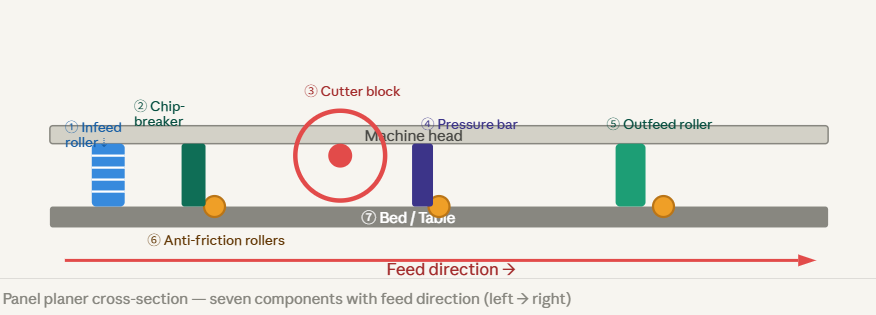
5. Draw and label a cross-section of a panel planer showing all seven key components and the feed direction.
EN
Seven components: ① Infeed roller (serrated), ② Chipbreaker, ③ Cutter block, ④ Pressure bar, ⑤ Outfeed roller (smooth), ⑥ Anti-friction rollers (bed), ⑦ Bed/table. Feed direction: left → right.
KR
7개 부품: ① 인피드 롤러(세레이션), ② 칩브레이커, ③ 커터 블록, ④ 프레셔 바, ⑤ 아웃피드 롤러(매끄러움), ⑥ 앤티 프릭션 롤러(베드), ⑦ 베드/테이블. 이송 방향: 좌 → 우.
6. List six pre-operational safety checks for the panel planer.
EN
1. All guards in place before starting. 2. Cutter knives are sharp and set to equal height. 3. Infeed and outfeed roller table heights matched to the machine bed. 4. Depth of cut set to no more than 3mm per pass. 5. Dust extraction system operational. 6. Timber checked for knots, metal (nails/screws), or other embedded objects.
KR
1. 시작 전 모든 가드 위치 확인. 2. 커터 날 날카롭고 동일한 높이로 설정. 3. 인피드/아웃피드 롤러 테이블 높이가 기계 베드와 일치. 4. 절삭 깊이를 1회 패스당 최대 3mm로 설정. 5. 집진 시스템 작동 확인. 6. 목재에 옹이, 금속(못/나사), 기타 이물질 유무 확인.
7. List six operational safety rules for using the panel planer.
EN
1. Never reach into the machine while running. 2. Stand to the side — not directly behind the outfeed end. 3. Support long material with roller stands or a second person. 4. Do not attempt to plane material shorter than 300mm. 5. Never look into the machine while it is cutting. 6. If material stalls, switch the machine off before attempting to clear it.
KR
1. 가동 중 기계 안으로 손을 뻗지 말 것. 2. 아웃피드 끝 바로 뒤가 아닌 옆에 서기. 3. 긴 재료는 롤러 스탠드나 보조 작업자로 지지. 4. 300 mm 미만 재료 절삭 시도 금지. 5. 절삭 중 기계 안을 들여다보지 말 것. 6. 재료가 멈추면 기계를 끄고 나서 해결 시도.
8. How should the grain direction of timber be oriented when feeding it into the panel planer, and why?
EN
Feed so the grain runs "downhill" in the direction of feed — the cutter meets the fibres from above as they slope away from it. This allows a clean slicing action. Feeding against the grain causes the cutters to lift fibres and create tearout. Visually: look at the side of the timber and feed so the grain lines angle toward the infeed end.
KR
나뭇결이 이송 방향으로 "내리막"이 되도록 이송 — 커터가 경사져 내려가는 섬유를 위에서 만나 깨끗한 절단이 가능하다. 결 반대 방향으로 이송하면 커터가 섬유를 들어올려 뜯김이 발생한다. 목재 측면을 보고 나뭇결 선이 인피드 끝 방향으로 기울어지도록 이송한다.
9. Briefly describe how you would dress both faces and edges of a piece of timber using the surface planer and panel planer together.
EN
Surface planer: dress the face flat (face mark it), then dress one edge square to the face (face edge mark it). Panel planer: place the face-marked surface face down on the bed and pass through at the required thickness — produces the opposite face parallel. The edge is then ripped to width on the rip saw using the face edge as the fence reference.
KR
서페이스 플레이너: 면을 평탄화(페이스 마크), 그다음 모서리를 면에 직각으로(페이스 엣지 마크). 패널 플레이너: 페이스 마크된 면을 베드에 아래로 놓고 필요한 두께로 통과 — 반대 면이 평행하게 생산된다. 그 다음 모서리는 페이스 엣지를 펜스 기준으로 사용해 립 쏘에서 폭으로 켠다.
10. What is a false table used for on a panel planer, and when would you need one?
EN
A false table is a flat board placed on the machine bed to raise the working height. It is used when planning timber that is thinner than the machine's minimum thickness setting — raising the working height allows the feed rollers to engage the stock properly. It also prevents very thin material from diving under the feed rollers.
KR
폴스 테이블은 기계 베드 위에 놓는 평평한 판재로 작업 높이를 높인다. 기계의 최소 두께 설정값보다 얇은 목재를 절삭할 때 사용 — 작업 높이를 높여 피드 롤러가 목재를 올바르게 잡을 수 있게 한다. 또한 매우 얇은 재료가 피드 롤러 아래로 빠지는 것도 방지한다.
11. Describe two methods for safely dressing short pieces of timber through a panel planer.
EN
Method 1 — Follow board:Attach the short piece to a longer "follow board" so they pass through together as one unit. The following board supports the short piece through the entire pass and prevents it from stalling at the infeed or outfeed rollers. Method 2 — End-to-end feeding:Feed several short pieces of equal thickness end-to-end, butted together. Each piece supports the next through the feed rollers — effectively creating a longer continuous piece.
KR
방법 1 — 폴로 보드:짧은 조각을 더 긴 "폴로 보드"에 부착하여 하나의 유닛으로 통과시킨다. 폴로 보드가 전체 패스에 걸쳐 짧은 조각을 지지하여 인피드/아웃피드 롤러에서 멈추는 것을 방지한다. 방법 2 — 끝-끝 이송:같은 두께의 짧은 조각 여러 개를 단단히 맞닿게 끝-끝으로 이송. 각 조각이 피드 롤러를 통해 다음 조각을 지지 — 사실상 더 긴 연속 조각을 만든다.
⑦ Sanding Machines
샌딩 기계 — 벨트, 디스크, 보빈
Belt, disc, and bobbin sanders serve different finishing roles. In boatbuilding, sanding is about fairing as much as finishing — the sequence of grits used determines how well a surface is prepared for coating. 벨트, 디스크, 보빈 샌더는 각각 다른 마감 역할을 담당한다. 보트빌딩에서 샌딩은 마감뿐 아니라 페어링에 관한 것 — 사용하는 그릿 순서가 도공 준비의 품질을 결정한다.
Study Questions · 학습 문제 — Sanding Machines
1. List six safety precautions that apply to all sanding machine operations.
EN
1. Wear a P2 dust mask — fine timber dust is a respiratory hazard that accumulates over time. 2. Start the dust extraction system before the machine. 3. Wear safety glasses to protect against airborne grit particles. 4. Never sand pieces too small to hold safely without a jig or fence. 5. Keep fingers clear of the belt edge and disc face at all times. 6. Do not use a torn, cracked, or damaged abrasive — replace it immediately.
KR
1. P2 방진 마스크 착용 — 미세 목재 분진은 시간이 지남에 따라 누적되는 호흡기 위험. 2. 기계 전에 집진 시스템 먼저 시작. 3. 공기 중 연마 입자로부터 보호하기 위해 안전안경을 착용. 4. 지그나 펜스 없이 안전하게 잡기. 너무 작은 조각은 절대 샌딩 금지. 5. 항상 벨트 모서리와 디스크 면에서 손가락을 유지. 6. 찢어지거나 균열되거나 손상된 연마재 사용 금지 — 즉시 교체.
2. Identify six points to check before operating a sanding machine.
EN
1. Belt tracking — centred on rollers with no drift to one side. 2. Belt/disc condition — no tears, cuts, or loaded (clogged) abrasive. 3. Table angle — set to the required angle (usually 90° to the abrasive surface). 4. Guards — all in position and functioning. 5. Extraction — hose connected, clear, and airflow confirmed. 6. Belt tension — correct so the belt runs without slipping under load.
KR
1. 벨트 트래킹 — 한쪽으로 드리프트 없이 롤러 중앙에서 주행. 2. 벨트/디스크 상태 — 찢김, 컷, 막힘(로딩) 없음. 3. 테이블 각도 — 필요한 각도(보통 연마 표면에 90°)로 설정. 4. 가드 — 모두 위치에 있고 작동 중. 5. 집진 — 호스 연결, 막힘 없음, 기류 확인. 6. 벨트 장력 — 부하 하에 슬립 없이 주행할 올바른 장력.
3. What factors should be considered when choosing which abrasive belt to use?
EN
①Grit:Coarser grits (40–60) for rapid stock removal; finer (120–180) for finishing. ②Abrasive mineral:Aluminium oxide for hardwood; zirconia for fast cutting on dense materials or FRP. ③Material type:Hardwood, softwood, and composites each have different demands. ④Backing:Cloth-backed for heavy use; paper-backed for light finishing.
KR
①그릿:거친(40–60) 빠른 재료 제거; 미세(120–180) 마감용. ②연마 광물:산화알루미늄(경재); 지르코니아(고밀도 재료나 FRP 고속 절삭). ③재료 종류:경재, 연재, 복합재 각각 다른 요구사항. ④백킹:천 백킹(heavy use); 종이 백킹(가벼운 마감).
4. What condition should the sanding pad (platen) be in, and why does it matter?
EN
The sanding pad must be perfectly flat — no hollows, ridges, or worn patches. The pad is the backing surface behind the belt; any imperfection transfers directly to the sanded surface. The pad material (usually graphite-impregnated) should also be smooth and low-friction to allow even pressure distribution.
KR
샌딩 패드는 완전히 평평해야 한다 — 오목함, 능선, 마모 부위가 없어야 한다. 패드는 벨트 뒤의 받침면; 어떤 결함도 샌딩 표면에 직접 전달된다. 패드 재료(보통 흑연 함침)도 고른 압력 분배를 위해 매끄럽고 저마찰이어야 한다.
5. In which direction should the joint of an abrasive belt face relative to the direction the belt travels, and what happens if it is fitted incorrectly?
EN
The belt joint must faceaway fromthe direction of travel — the leading edge of the joint points backwards so the belt runs smoothly over it. If installed the wrong way, the forward-facing leading edge of the joint catches on the workpiece, which can tear the belt apart or cause the joint to fail at speed — a safety hazard.
KR
벨트 접합부는 이송 방향반대 방향으로 향해야 한다 — 접합부의 앞 엣지가 뒤를 향해야 벨트가 부드럽게 넘어간다. 반대로 설치하면 접합부의 앞 엣지가 가공물에 걸려 벨트가 찢어지거나 고속에서 접합부가 파단될 수 있다 — 안전 위험.
6. How is an abrasive disc attached to the metal plate of a disc sander, and what are the two common systems?
EN
PSA (pressure-sensitive adhesive):The disc has a peel-and-stick backing — applied directly to the metal plate and peeled off when worn. Simple and cheap.Hook-and-loop (Velcro-type):The disc attaches to a corresponding hook surface on the plate — allows faster disc changes and is reusable more easily, though slightly more expensive.
KR
PSA(압감형 접착제):디스크에 떼었다 붙이는 백킹이 있어 금속 플레이트에 직접 부착하고 마모 시 떼어낸다. 간단하고 저렴하다.훅앤루프(벨크로 방식):플레이트의 훅 표면에 부착 — 더 빠른 디스크 교체와 재사용이 용이하지만 약간 더 비싸다.
7 & 8. On which side of the disc should timber be placed, and why is using the other side dangerous?
EN
Always use theleft side(the downward-moving half when facing the disc). Here, disc rotation pushes the workdownonto the table, keeping it stable and controlled. On the right side (upward-moving half), rotation pushes the workup and awayfrom the table, making it impossible to control and creating a serious throwing hazard.
KR
항상왼쪽(디스크를 바라볼 때 아래로 이동하는 절반)을 사용한다. 여기서 디스크 회전이 작업물을 테이블아래로밀어 안정적으로 제어된다. 오른쪽(위로 이동하는 절반)에서는 회전으로 작업물을 테이블에서위로 밀어 올려제어 불가능하고 심각한 날아감 위험이 생긴다.
9. Describe the step-by-step process for changing the bobbin on a bobbin sander.
EN
1. Switch off and isolate the machine. 2. Remove the table insert ring for the current bobbin size. 3. Unscrew or unclip the spindle nut/cap and slide off the old bobbin. 4. Fit the correct new bobbin diameter for the required curve. 5. Tighten the nut to expand the rubber drum against the abrasive sleeve. 6. Fit the matching table insert ring for the new diameter. 7. Confirm the bobbin is fully secure before restarting.
KR
1. 기계를 끄고 전원 차단. 2. 현재 보빈 크기에 맞는 테이블 인서트 링 제거. 3. 스핀들 너트/캡을 풀거나 클립을 해제한 후 구형 보빈을 빼낸다. 4. 필요한 곡선에 맞는 새 보빈 직경을 끼운다. 5. 너트를 조여 고무 드럼이 연마 슬리브에 팽창되도록 한다. 6. 새 직경에 맞는 테이블 인서트 링을 장착한다. 7. 재시작 전 보빈이 완전히 단단히 고정됐는지 확인.
10. What is the maximum acceptable gap between the bobbin and the table insert, and why must this be controlled?
EN
The gap should be no more than1–2mm. A larger gap allows the edge of thin workpieces to dip into the gap during sanding — creating an uneven sanded edge and presenting a pinch or snatch hazard where the workpiece can be grabbed and pulled into the gap. The insert ring size must always match the bobbin diameter fitted.
KR
간격은 최대1–2mm를 초과하지 않아야 한다. 더 큰 간격에서는 얇은 가공물의 모서리가 샌딩 중 간격으로 빠질 수 있어 — 불균일한 샌딩 모서리가 생기고 가공물이 간격으로 잡혀 끌려 들어가는 끼임/잡아챔 위험이 발생한다. 인서트 링 크기는 항상 장착된 보빈 직경과 일치해야 한다.
⑧ Vertical Drill Press (Pedestal Drill)
수직 드릴 프레스 / 페데스탈 드릴
Drills accurate, repeatable holes at controlled depths and angles — far more precise and safer for structural work than a handheld drill. In boatbuilding: fastening holes, keel bolt bores, shaft log preparation, and treenail drilling. 정확하고 반복 가능한 구멍을 제어된 깊이와 각도로 뚫는다 — 구조 작업에서 핸드헬드 드릴보다 훨씬 정밀하고 안전하다.
Study Questions · 학습 문제 — Drill Press
1. What advantages does a vertical drill press offer over a handheld drill for structural boatbuilding work?
EN
The drill press holds the bit rigidly perpendicular to the work surface, applies a consistent, controlled downward force, and allows precise depth control via the depth stop. Handheld drills wander, tilt, and cannot reliably repeat hole depths — all critical limitations when drilling structural fastening holes, keel bolt bores, or shaft alignment holes in a boat.
KR
드릴 프레스는 비트를 작업 표면에 수직으로 단단히 고정하고, 일정하고 제어된 아래 방향의 힘을 가하며, 뎁스 스톱을 통해 정밀한 깊이 조절이 가능하다. 핸드헬드 드릴은 흔들리고 기울어지며 구멍 깊이를 신뢰성 있게 반복할 수 없다 — 선박의 구조적 패스닝 구멍, 킬 볼트 보링, 샤프트 얼라인먼트 구멍을 뚫을 때 모두 중요한 한계점이다.
2. How is the table height adjusted on a drill press, and what precautions should be taken before releasing the lock?
EN
Loosen the table lock collar on the column, adjust the table to the required height, then re-tighten the lock firmly. Before releasing the lock on a heavy table, support it from below — an unsupported table can drop suddenly and unexpectedly when the lock is released, damaging the machine or injuring the operator.
KR
컬럼의 테이블 잠금 칼라를 풀고, 필요한 높이로 조정한 후 잠금 칼라를 단단히 다시 조인다. 무거운 테이블에서 잠금을 해제하기 전에 아래에서 지지하라 — 지지되지 않은 테이블은 잠금 해제 시 갑자기 예상치 못하게 떨어져 기계를 손상시키거나 작업자를 다치게 할 수 있다.
3. Describe the full process for changing the speed on a drill press, and what is the general rule for selecting the correct speed?
EN
1. Switch off and isolate the machine — never change speed while running. 2. Open the top cover to access the belt and stepped-pulley system. 3. Release belt tension by moving the motor plate (lever or adjustment bolt). 4. Reposition the belt on the required step combination on both the motor and spindle pulleys. 5. Re-tension the belt and close the cover before restarting. Speed rule:Large bits and hardwood = slow. Small bits and softwood = fast. Higher speed on hard material causes overheating and dulling.
KR
1. 기계를 끄고 전원 차단 — 가동 중 속도 변경 절대 금지. 2. 벨트·단계 풀리 시스템에 접근하기 위해 상단 커버를 연다. 3. 모터 플레이트를 이동(레버 또는 조정 볼트)하여 벨트 장력을 해제한다. 4. 모터와 스핀들 풀리 양쪽에서 필요한 단계 조합에 따라 벨트를 재위치한다. 5. 재시작 전 벨트를 다시 장력 조정하고 커버를 닫는다. 속도 규칙:큰 비트와 경재 = 저속. 작은 비트와 연재 = 고속. 단단한 재료에서 고속은 과열과 날 마모를 유발한다.
4. What is the depth gauge (depth stop) on a drill press for, and how is it set correctly?
EN
The depth stop limits the maximum downward travel of the quill, controlling hole depth. To set: lower the quill until the bit tip is at the required final depth (with the bit touching the work surface as the datum), then adjust the depth stop nut to contact the collar at that exact position and lock it. Every hole drilled subsequently will be identical in depth.
KR
뎁스 스톱은 퀼의 최대 하향 이동을 제한하여 구멍 깊이를 조절한다. 설정 방법: 비트 끝이 필요한 최종 깊이에 오도록 퀼을 내리고(비트가 작업 표면에 닿는 것을 기준점으로), 뎁스 스톱 너트가 칼라에 정확히 그 위치에서 닿도록 조정하고 잠근다. 이후 뚫는 모든 구멍의 깊이가 동일하다.
5. List ten safe working practices when operating a vertical drill press.
EN
1. Always clamp the workpiece — never hold by hand while drilling. 2. Remove the chuck key completely before starting. 3. Wear safety glasses throughout. 4. Select the correct speed for bit size and material type. 5. Place a backing board under the work to prevent breakout and protect the table. 6. Apply smooth, even downward pressure — never force the bit. 7. Periodically withdraw the bit to clear chips (peck drilling). 8. Lower the guard or shield before starting. 9. Never wear gloves near a rotating chuck — gloves can catch and pull the hand in. 10. Never leave the machine running unattended.
KR
1. 가공물은 항상 클램프로 — 드릴링 중 손으로 잡고 있는 것은 절대 금지. 2. 시작 전 척 키를 완전히 제거. 3. 전체 작업 중 안전안경 착용. 4. 비트 크기와 재료 종류에 맞는 올바른 속도 선택. 5. 뚫림 방지와 테이블 보호를 위해 작업물 아래 배킹 보드 사용. 6. 부드럽고 고른 아래 방향 압력 — 절대 비트를 강제로 밀어넣지 말 것. 7. 칩 제거를 위해 주기적으로 비트를 뽑아 올림(펙 드릴링). 8. 시작 전 가드/실드를 내림. 9. 회전하는 척 근처에서 장갑 착용 금지 — 장갑이 걸려 손이 빨려 들어갈 수 있음. 10. 기계를 켜 둔 채 자리를 비우지 말 것.